
Samsung’s AI Memory Gold Rush: Profits Triple Amid Chip Crunch

Emily Scott
Emily Scott

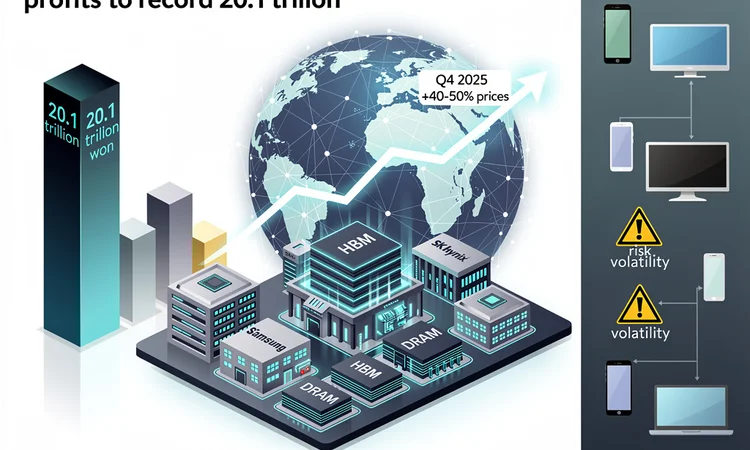
Samsung Electronics tripled Q4 2025 profits to a record 20.1 trillion won, fueled by AI-driven HBM demand and memory shortages that surged prices 40-50%. The boom benefits giants like Samsung and SK Hynix, but risks loom for consumer segments.

Samsung’s AI Memory Gold Rush: Profits Triple Amid Chip Crunch

Samsung Electronics Co. unveiled staggering fourth-quarter results for 2025, with operating profit soaring more than threefold to a record 20.1 trillion Korean won ($14 billion), eclipsing analyst forecasts and the company’s own guidance. Revenue climbed 24% year-over-year to 93.8 trillion won ($65.58 billion), marking a fresh quarterly high. This windfall stems from explosive demand for high-bandwidth memory chips powering AI data centers, which has triggered widespread shortages and skyrocketed prices across memory types.

The semiconductor division, Samsung’s powerhouse, notched all-time highs in revenue and profit, propelled by a market-wide price surge, robust sales of high-value HBM products, and other premium offerings. Makers like Nvidia Corp. are vying for scant HBM supplies, with demand far exceeding availability. As producers such as Samsung reroute capacity to these high-margin AI essentials, supplies of standard DRAM and NAND for PCs and mobiles have tightened, boosting prices 40%-50% in the quarter, according to CNBC .

Record Breaker Shatters 2018 Peak

This performance vaults past Samsung’s prior benchmark of 17.6 trillion won from Q3 2018, during the last memory boom. Full-year 2025 operating profit hit 43.53 trillion won, up 33% from 2024, with sales rising 10.6% to 332.77 trillion won. Counterpoint Research dubbed the phase a ‘Hyper-Bull’ market, outstripping 2018 peaks, with supplier leverage at historic highs from AI and server hunger.

Samsung trails rival SK Hynix Inc. in HBM supremacy but dominates NAND and leverages conventional DRAM strength. SK Hynix, reporting record earnings earlier, saw FY2025 revenue of 97.1467 trillion won and Q4 operating profit of 19.1696 trillion won, fueled by HBM leadership. Samsung’s HBM shipments are poised to triple in 2026 as HBM4 ramps up, per analysts cited in Yahoo Finance .

HBM Frenzy Squeezes Broader Supplies

AI hyperscalers like Meta Platforms Inc. and Amazon.com Inc. are snapping up DRAM at premiums, as noted by CLSA’s Sanjeev Rana: “Hyperscalers and cloud providers are buying a lot of DRAM and they are willing to pay a price premium.” DDR5 contract prices leaped 313% year-over-year, per TrendForce data referenced in Reuters . Spot prices for mainstream DRAM surged 18-23% in Q4 alone.

Makers are diverting factories from consumer chips to AI-grade HBM, exacerbating shortages. Micron Technology Inc. CEO Sanjay Mehrotra warned markets will stay tight beyond 2026, meeting only half to two-thirds of key customer needs. Samsung plans aggressive HBM4 expansion for Nvidia’s Rubin platform, with CEO Jun Young-hyun noting customer praise: “Samsung is back.”

Rivals Ride the Wave, Foundry Edges Up

SK Hynix’s blockbuster results underscore the sector surge, with 58% operating margins and 2026 demand forecasts of +20% for DRAM and +18% for NAND, as shared by Counterpoint Research VP Neil Shah on X. Samsung’s non-memory units, including foundry and system LSI, narrowed losses to about 800 billion won in Q4 from mid-2 trillion won earlier in 2025, aided by a weaker won.

The mobile division held profitability at 2-3 trillion won despite rising component costs pinching margins. Display profits grew on Apple Inc.’s iPhone 17 sales. Samsung eyes Qualcomm for 2nm chip contracts and Intel for 8nm foundry work, per KED Global .

2026 Horizons: Capacity Race Accelerates

Memory prices could rise another 40-50% in Q1 2026, then 20% in Q2, with DDR5 RDIMMs potentially doubling by year-end. Samsung warns shortages will hike prices industry-wide, impacting its own gadgets. HBM orders secure visibility into 2026, with capex rising for U.S. expansion and MLCC/FC-BGA amid AI server demand, as Citi noted for Samsung Electro-Mechanics.

Analysts like DB Securities’ Seo Seung-yeon flag risks: soaring prices may curb PC/smartphone demand, while AI data centers lean on debt. Yet, AI server shipments could grow 80% in 2026, per reports, sustaining tightness. Samsung’s scale positions it to capture gains as factories, power grids, and packaging like TSMC’s CoWoS hit full utilization.

Investor Calculus in Volatile Boom

Shares jumped 125% in 2025, the best in 26 years, but dipped post-earnings on profit-taking. Valuation concerns linger amid potential demand slowdowns, as BNK’s Lee Min-hee cautioned on PC/smartphone pressures and AI financing risks. Still, with Nvidia’s Rubin on track and custom TPUs boosting HBM, Samsung’s dual exposure to conventional and advanced memory fortifies its stance in this protracted upcycle.

About the Author

Emily Scott
Emily Scott

As a writer, Emily Scott covers consumer behavior with an eye for detail. They work through clear frameworks, case studies, and practical checklists to make complex topics approachable. They value transparent sourcing and prefer primary data when it is available. A recurring theme in their writing is how teams build repeatable systems and measure impact over time. They often cover how organizations respond to change, from process redesign to technology adoption. Their reporting blends qualitative insight with data, highlighting what actually changes decision‑making. They emphasize responsible innovation and the constraints teams face when scaling products or services. They maintain a balanced tone, separating speculation from evidence. Their coverage includes guidance for teams under resource or time constraints. Readers appreciate their ability to connect strategic goals with everyday workflows. They write about both the promise and the cost of transformation, including risks that are easy to overlook. They tend to favor small experiments over sweeping predictions. They value transparency, practical advice, and honest uncertainty.

Comments

Join the discussion and share your thoughts.

No comments yet. Be the first to comment.

Leave a Reply

Your email address will not be published.

Related Posts

Atlantic’s $1.2 Billion Staffing Power Play: F1 Tech Talent Fuels Transatlantic Surge

Atlantic’s $1.2 Billion Staffing Power Play: F1 Tech Talent Fuels Transatlantic Surge

Atlantic International Corp. acquires Circle8 Group in an all-stock deal, creating a $1.2 billion global staffing platform blending U.S. industrial and European IT talent. Circle8's Aston Martin F1 partnership highlights its elite capabilities amid cross-selling potential.

Posted on: by Liam Price
Bots at Work: Service Robotics’ $500 Billion Surge Reshapes Labor Markets

Bots at Work: Service Robotics’ $500 Billion Surge Reshapes Labor Markets

Service robotics rockets toward $498 billion by 2033 at 37% CAGR, automating logistics, healthcare, and hospitality amid AI advances and labor crunches. Deals like Serve's Diligent buy propel indoor expansions.

Posted on: by Layla Reed
Aspire-Deel Tie-Up Reshapes Global Hiring for Fintech Startups

Aspire-Deel Tie-Up Reshapes Global Hiring for Fintech Startups

Aspire integrates Deel's EOR services for seamless global hiring and finance management, targeting startups scaling internationally. The partnership addresses compliance hurdles, offering unified insights into workforce costs and cash flow.

Business
Deel’s Record-Breaking Hiring Spectacle: AI-Powered Push Reshapes Global Talent Wars

Deel’s Record-Breaking Hiring Spectacle: AI-Powered Push Reshapes Global Talent Wars

Deel shattered records with 6,848 attendees at its largest online hiring event, blending AI tools and global reach to fill 300+ sales roles. Amid growth to $17.3 billion valuation, the feat highlights innovations in HR and payroll but sparks debate on stunt versus substance.

Business
Deel’s $17 Billion Sprint: From Y Combinator to Global Payroll Powerhouse

Deel’s $17 Billion Sprint: From Y Combinator to Global Payroll Powerhouse

Deel rocketed to a $17.3 billion valuation in seven years by pioneering owned global payroll infrastructure, processing $22 billion annually for 37,000 firms. Amid IPO prep and DOJ scrutiny, COO Dan Westgarth reveals elite ops driving $1 billion revenue.

Business
HR’s AI Superagent Revolution: Reinventing the Workforce Engine

HR’s AI Superagent Revolution: Reinventing the Workforce Engine

Enterprise AI Superagents ignite HR's biggest transformation in decades, automating 30-40% of jobs while birthing full-stack roles and skills-first strategies. Josh Bersin leads the charge amid bias risks and tech trends reshaping hiring, experience, and leadership.

Business
AI’s HR Reckoning: 10 Pivotal Shifts Reshaping Workforce Strategies in 2026

AI’s HR Reckoning: 10 Pivotal Shifts Reshaping Workforce Strategies in 2026

As AI propels organizations into hybrid human-machine teams, HR must master fluency screening, skills-based shifts and agentic governance to thrive amid 2026's disruptions, blending tech efficiency with human resilience.

Business
The Upselling Paradox: How Retailers Walk the Tightrope Between Revenue Growth and Consumer Trust

The Upselling Paradox: How Retailers Walk the Tightrope Between Revenue Growth and Consumer Trust

New research reveals upselling's hidden risks as retailers balance revenue growth with customer trust. While upselling can boost transaction values by 10-30%, approximately 23% of consumers experience post-purchase regret, potentially damaging long-term profitability and brand reputation in an increasingly skeptical marketplace.

Business
Chrome Extensions’ Silent Siege on Enterprise HR Crown Jewels

Chrome Extensions’ Silent Siege on Enterprise HR Crown Jewels

Five malicious Chrome extensions hijacked sessions on Workday, NetSuite, and SAP SuccessFactors, stealing cookies, blocking admin pages, and enabling takeovers. Socket's discovery prompted Google takedowns after 2,300 installs, exposing enterprise browser risks.

Business
AI Proficiency Divide: HR’s Mounting Crisis

AI Proficiency Divide: HR’s Mounting Crisis

Corporate AI adoption surges, but superficial employee use creates a proficiency chasm now demanding HR intervention through targeted training, outcome metrics, and equity for overlooked workers.

Business