
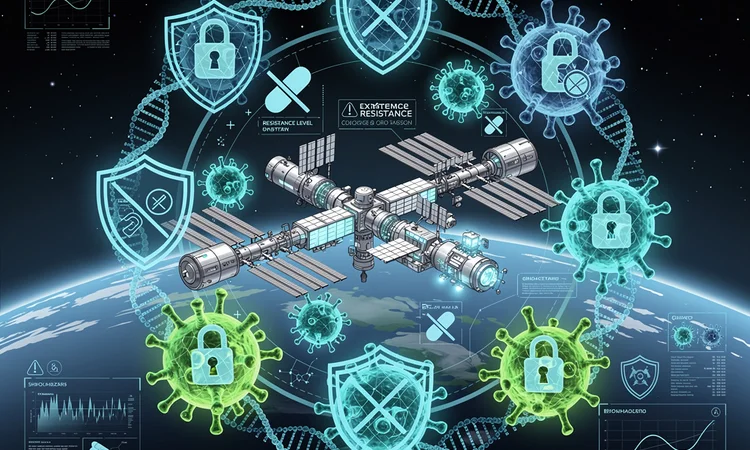
Bacteria aboard the International Space Station have developed mutations that grant them extraordinary abilities to resist antibiotics and survive in extreme conditions, raising profound questions about the future of long-duration space missions and the potential risks astronauts may face. According to research highlighted by Slashdot , these microorganisms have undergone genetic changes that enable them to thrive in the harsh environment of space, developing capabilities that their Earth-bound counterparts do not possess.
The discovery comes at a critical juncture as NASA and other space agencies plan missions to Mars and establish permanent lunar bases. Scientists have long known that the space environment—characterized by microgravity, increased radiation exposure, and confined living quarters—creates unique stressors for all living organisms. However, the extent to which bacteria can adapt and evolve in these conditions has surprised even seasoned researchers who study microbial behavior in extreme environments.
Genetic Adaptation in Microgravity Environments
The bacteria studied aboard the ISS belong to several species commonly found in human environments, including strains of Enterobacter and Staphylococcus. What makes these space-dwelling microbes particularly concerning is their accelerated mutation rate compared to identical strains maintained on Earth. The microgravity environment appears to trigger genetic changes that enhance bacterial survival mechanisms, including the development of biofilms—protective matrices that shield bacterial colonies from both environmental threats and antimicrobial treatments.
Research teams have documented that these mutations are not random but appear to follow specific pathways that enhance the bacteria’s ability to cope with stress. The confined, enclosed environment of the space station, combined with the constant presence of human inhabitants, creates a unique evolutionary pressure cooker. Bacteria that develop resistance to cleaning agents and antibiotics gain a significant survival advantage, leading to the rapid spread of these traits through bacterial populations.
Implications for Astronaut Health and Safety
The health implications for astronauts are substantial and multifaceted. During long-duration missions, astronauts already experience compromised immune function due to the effects of microgravity and radiation exposure. When coupled with the presence of increasingly resistant bacteria, this creates a potentially dangerous situation. Minor infections that would be easily treatable on Earth could become serious medical emergencies during a Mars mission, where immediate evacuation is impossible and medical resources are severely limited.
Medical protocols for space missions may require complete overhaul in light of these findings. Current antibiotic regimens carried aboard spacecraft were designed based on terrestrial bacterial profiles. If space-adapted bacteria demonstrate resistance to these standard treatments, mission planners will need to develop new approaches to infection prevention and treatment. This could include carrying broader spectrum antibiotics, implementing more rigorous sterilization protocols, or developing entirely new antimicrobial strategies specifically designed for the space environment.
The Role of Radiation and Environmental Stress
Cosmic radiation, which penetrates spacecraft despite shielding efforts, plays a significant role in driving bacterial mutations. Unlike Earth, where our planet’s magnetic field and atmosphere provide substantial protection from space radiation, the ISS and future deep-space vehicles offer only limited shielding. This constant bombardment of high-energy particles can damage DNA in both human cells and bacterial cells, but bacteria’s rapid reproduction rate allows beneficial mutations to spread quickly through populations.
Scientists have observed that bacteria in space don’t just survive—they adapt with remarkable efficiency. The combination of radiation-induced mutations and selective pressure from cleaning agents and antibiotics creates an evolutionary fast lane. Some bacterial strains have developed enhanced DNA repair mechanisms, allowing them to better cope with radiation damage while simultaneously maintaining mutations that confer antibiotic resistance. This dual capability represents a significant challenge for maintaining sterile environments in spacecraft.
Biofilm Formation and Spacecraft Infrastructure
One of the most concerning developments is the enhanced ability of space-adapted bacteria to form robust biofilms on spacecraft surfaces. These biofilms are not merely cosmetic issues; they can interfere with equipment function, corrode materials, and serve as reservoirs of potentially pathogenic bacteria. The ISS has documented instances where biofilms have formed on critical systems, requiring extensive cleaning and maintenance procedures that consume valuable crew time and resources.
The biofilm problem becomes even more acute when considering future missions. A journey to Mars could take six to nine months each way, providing ample time for bacterial colonies to establish themselves throughout a spacecraft. Once established, biofilms are notoriously difficult to eradicate, often requiring mechanical removal in addition to chemical treatments. In the confined quarters of a spacecraft, with limited ability to replace contaminated components, persistent biofilms could pose ongoing health and operational risks.
Lessons from Closed Environment Research
The space station serves as an invaluable laboratory for understanding microbial behavior in closed environments, with applications extending beyond space exploration. Submarines, Antarctic research stations, and other isolated facilities face similar challenges with microbial contamination. The research conducted aboard the ISS provides insights that could improve infection control in these terrestrial settings as well. Understanding how bacteria evolve in response to confined conditions and limited microbial diversity helps scientists develop better strategies for managing microbial communities in any closed system.
Interestingly, not all microbial evolution in space is problematic. Some researchers are exploring whether certain beneficial bacteria might also thrive in space conditions, potentially offering probiotic benefits to astronauts or serving useful functions in life support systems. The key is understanding and managing the microbial ecosystem rather than attempting to achieve complete sterility, which has proven both impossible and potentially counterproductive.
Future Research Directions and Countermeasures
Space agencies are now investing heavily in understanding these microbial mutations and developing countermeasures. Advanced monitoring systems are being developed to track bacterial populations aboard spacecraft in real-time, allowing crew members to identify and address contamination issues before they become serious. Novel antimicrobial materials and surface treatments are being tested that could reduce bacterial colonization of spacecraft surfaces without relying on traditional antibiotics.
Genetic sequencing technology has advanced to the point where astronauts can now sequence bacterial DNA aboard the ISS, providing immediate information about the genetic makeup of microbial populations. This capability will be crucial for long-duration missions, allowing crews to identify emerging resistance patterns and adjust their infection control strategies accordingly. Some researchers are even exploring the possibility of using bacteriophages—viruses that specifically target bacteria—as an alternative to antibiotics in the space environment.
Preparing for Deep Space Exploration
As humanity prepares for missions beyond low Earth orbit, the lessons learned from ISS microbiology research become increasingly critical. A Mars mission will require unprecedented levels of self-sufficiency, including the ability to diagnose and treat infections without support from Earth. The discovery of enhanced bacterial resistance in space environments underscores the need for comprehensive planning and preparation. Mission designers must account for the evolutionary potential of microorganisms, not just their current state.
The challenge extends to planetary protection protocols as well. If Earth bacteria can rapidly evolve enhanced survival capabilities in space, the risk of contaminating other worlds with hardy, potentially invasive terrestrial microorganisms increases. This adds another dimension to the already complex task of ensuring that human exploration doesn’t compromise the scientific integrity of pristine extraterrestrial environments or potentially harm any native life forms that might exist.
The remarkable adaptability of bacteria in space serves as both a warning and an opportunity. While the development of antibiotic resistance poses clear risks, it also demonstrates life’s extraordinary capacity to adapt to new environments. Understanding these mechanisms could lead to breakthroughs in medicine, biotechnology, and our fundamental understanding of evolution. As we venture further into space, we carry with us not just human explorers but entire ecosystems of microorganisms that will continue to evolve alongside us, shaping and being shaped by the final frontier in ways we are only beginning to understand.


Leave a Reply
Your email address will not be published.