
Starbucks’ Bold Bet: 3% Comps, 15% Margins by 2028 Amid Turnaround Surge

Emily Chen
Emily Chen

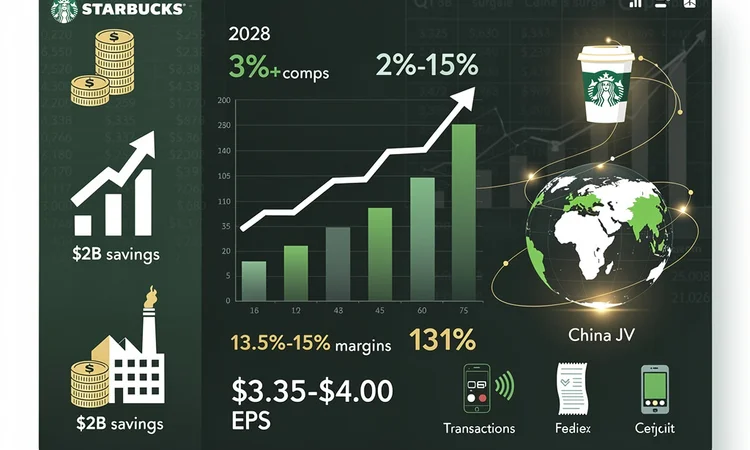
Starbucks unveiled fiscal 2028 targets of 3%+ comps, 13.5%-15% margins, and $3.35-$4.00 EPS at investor day, fueled by transactions, $2B savings, and China JV. CFO Cathy Smith sees clear path amid Q1 sales surge.

Starbucks’ Bold Bet: 3% Comps, 15% Margins by 2028 Amid Turnaround Surge

NEW YORK—Starbucks Corp. executives laid out an ambitious financial roadmap through fiscal 2028 at their first investor day under CEO Brian Niccol, signaling confidence in the “Back to Starbucks” transformation plan a year after its launch. CFO Cathy Smith, speaking to CNBC , emphasized the timing: “We set the Back to Starbucks plan a year ago… it’s clear now we’re seeing the momentum and the plan is working.” The event highlighted transaction-driven sales growth, $2 billion in targeted cost savings, and a pivotal China joint venture, even as near-term earnings face headwinds from investments and commodity pressures.

In the first quarter of fiscal 2026, Starbucks reported global comparable store sales up 4%, with U.S. comps matching that figure on 3% transaction growth and 1% higher average ticket, per the company’s Q1 earnings release . This marked the first U.S. transaction increase in eight quarters. For full-year 2026, management guided to global and U.S. comp sales growth of 3% or better, non-GAAP EPS of $2.15 to $2.40, and 600 to 650 net new stores globally. Consolidated net revenues rose 6% to $9.9 billion in the quarter, though non-GAAP EPS of $0.56 missed estimates amid labor and remodel investments.

Turnaround Momentum Builds on Transactions

Smith underscored the durability of 3% comps as a baseline for Starbucks’ scale: “3% comp is a really good comp for our size scale and our global nature… underpinned by transactions.” Q1’s 4% global comp reflected 3% traffic gains, reversing prior declines. Executives attributed this to Green Apron Service rollout, which boosted peak throughput to under four minutes in cafes and drive-thrus, according to the Investor Day press release . COO Mike Grams noted: “Great execution creates better experiences, which drives repeat visits and fuels growth.”

Menu innovations and brand marketing form demand drivers, with new espresso, matcha, chai, and Energy Refreshers slated for 2026. A reimagined Rewards program launches March 10 with Green, Gold, and Reserve tiers, faster star earning, non-expiring stars for higher levels, and perks like free monthly customizations—driving nearly 60% of U.S. sales. Chief Brand Officer Tressie Lieberman said: “We’re not chasing trends. We’re building on a beloved platform.”

Store uplifts, costing $150,000 each versus prior multimillion-dollar remodels, will add 25,000 U.S. seats by year-end 2026, per Reuters . Plans call for 400 net new U.S. company-operated stores annually by 2028, targeting 5,000 additional long-term opportunities.

Margin Push Prioritizes Savings Over Pricing

Starbucks targets non-GAAP consolidated operating margins of 13.5% to 15% by fiscal 2028—pre-pandemic levels—via 5%+ annual revenue growth, 3%+ comps, 2%-3% from new stores, and over $2 billion in cost savings. Smith clarified to CNBC: “Margin growth is first going to come from probably not pricing for us. Pricing is going to be our last lever.” Value scores hit all-time highs across age groups, enabling selective inflation-linked hikes.

Cost discipline spans 90+ initiatives, including cheaper remodels, supply chain fixes aiming for 90% daily resupply by 2026 end, and AI tools like Green Dot Assist for drive-thru order-taking and automated counting. Smith added: “Technology can do the work in the background… preserve that customer-barista connection.” International margins, 13% in fiscal 2025, eye high-teens post-China shift, per CNBC coverage.

Fiscal 2028 non-GAAP EPS guidance stands at $3.35 to $4.00, with over 2,000 net new global stores. Smith told investors: “Starbucks has enduring strengths and we are building on them. Our financial framework shows how we will translate our ‘Back to Starbucks’ strategy into sustainable, profitable growth.”

China Venture Trades Earnings for Acceleration

China, with 8,000 stores in tier-one and two cities, faces a joint venture with Boyu Capital closing Q2 2026, granting Boyu up to 60% stake at a $4 billion enterprise value—total business worth over $13 billion including Starbucks’ 40% retained interest and licensing fees. Smith noted to CNBC: “We’re really optimistic about China long term… our capital partner has bigger growth expectations” to offset modest dilution, potentially 15 cents to 2028 EPS under current plans.

The asset-light model mirrors McDonald’s, enabling expansion into tier-three-plus cities toward 15,000-20,000 stores, doubling international footprint to 40,000. International CEO Brady Brewer affirmed: “The role of our international business is very clear. We are an asset-light growth driver.” Forecasts assume ongoing China retail operations, with JV upside for higher growth.

Beyond 2028: Supply Chain, Units Fuel Upside

Smith highlighted post-2028 levers: “We still have work to do in our supply chain… as we build new coffee houses with a better cost profile.” Even at 400 annual U.S. openings against a 10,100-store base, improved economics will gradually lift P&L. Niccol affirmed: “This is just a waypoint… ambitions extend well beyond this timeline.”

Q1 results and guidance reflect abating coffee volatility and tariffs, with prices rolling through inventory but maintaining value. Smith said: “Coffee prices should be coming down… our coffee prices in the coffee houses to our customers are at a great value.” Shares have risen 15% in early 2026, outperforming peers, though profitability lags amid investments, as noted in U.S. News .

The roadmap positions Starbucks for sustained growth, blending operational rigor with innovation. As Smith concluded on CNBC: “The first one is always going to be on topline… if we keep doing the right things, having a great customer experience.” Investors await execution amid consumer pressures and competition.

About the Author

Emily Chen
Emily Chen

Known for clear analysis, Emily Chen follows retail operations and the people building it. They work through clear frameworks, case studies, and practical checklists to make complex topics approachable. They often cover how organizations respond to change, from process redesign to technology adoption. Readers appreciate their ability to connect strategic goals with everyday workflows. They examine how customer expectations evolve and how organizations adapt to meet them. They value transparent sourcing and prefer primary data when it is available. A recurring theme in their writing is how teams build repeatable systems and measure impact over time. They also highlight cultural factors that determine whether change sticks. They avoid buzzwords, focusing instead on outcomes, incentives, and the human side of technology. They explore how policies, markets, and infrastructure intersect to create second‑order effects. They believe good analysis should be specific, testable, and useful to practitioners. They tend to favor small experiments over sweeping predictions. They value transparency, practical advice, and honest uncertainty.

Comments

Join the discussion and share your thoughts.

No comments yet. Be the first to comment.

Leave a Reply

Your email address will not be published.

Related Posts

Atlantic’s $1.2 Billion Staffing Power Play: F1 Tech Talent Fuels Transatlantic Surge

Atlantic’s $1.2 Billion Staffing Power Play: F1 Tech Talent Fuels Transatlantic Surge

Atlantic International Corp. acquires Circle8 Group in an all-stock deal, creating a $1.2 billion global staffing platform blending U.S. industrial and European IT talent. Circle8's Aston Martin F1 partnership highlights its elite capabilities amid cross-selling potential.

Posted on: by Liam Price
Bots at Work: Service Robotics’ $500 Billion Surge Reshapes Labor Markets

Bots at Work: Service Robotics’ $500 Billion Surge Reshapes Labor Markets

Service robotics rockets toward $498 billion by 2033 at 37% CAGR, automating logistics, healthcare, and hospitality amid AI advances and labor crunches. Deals like Serve's Diligent buy propel indoor expansions.

Posted on: by Layla Reed
Aspire-Deel Tie-Up Reshapes Global Hiring for Fintech Startups

Aspire-Deel Tie-Up Reshapes Global Hiring for Fintech Startups

Aspire integrates Deel's EOR services for seamless global hiring and finance management, targeting startups scaling internationally. The partnership addresses compliance hurdles, offering unified insights into workforce costs and cash flow.

Business
Deel’s Record-Breaking Hiring Spectacle: AI-Powered Push Reshapes Global Talent Wars

Deel’s Record-Breaking Hiring Spectacle: AI-Powered Push Reshapes Global Talent Wars

Deel shattered records with 6,848 attendees at its largest online hiring event, blending AI tools and global reach to fill 300+ sales roles. Amid growth to $17.3 billion valuation, the feat highlights innovations in HR and payroll but sparks debate on stunt versus substance.

Business
Deel’s $17 Billion Sprint: From Y Combinator to Global Payroll Powerhouse

Deel’s $17 Billion Sprint: From Y Combinator to Global Payroll Powerhouse

Deel rocketed to a $17.3 billion valuation in seven years by pioneering owned global payroll infrastructure, processing $22 billion annually for 37,000 firms. Amid IPO prep and DOJ scrutiny, COO Dan Westgarth reveals elite ops driving $1 billion revenue.

Business
HR’s AI Superagent Revolution: Reinventing the Workforce Engine

HR’s AI Superagent Revolution: Reinventing the Workforce Engine

Enterprise AI Superagents ignite HR's biggest transformation in decades, automating 30-40% of jobs while birthing full-stack roles and skills-first strategies. Josh Bersin leads the charge amid bias risks and tech trends reshaping hiring, experience, and leadership.

Business
AI’s HR Reckoning: 10 Pivotal Shifts Reshaping Workforce Strategies in 2026

AI’s HR Reckoning: 10 Pivotal Shifts Reshaping Workforce Strategies in 2026

As AI propels organizations into hybrid human-machine teams, HR must master fluency screening, skills-based shifts and agentic governance to thrive amid 2026's disruptions, blending tech efficiency with human resilience.

Business
The Upselling Paradox: How Retailers Walk the Tightrope Between Revenue Growth and Consumer Trust

The Upselling Paradox: How Retailers Walk the Tightrope Between Revenue Growth and Consumer Trust

New research reveals upselling's hidden risks as retailers balance revenue growth with customer trust. While upselling can boost transaction values by 10-30%, approximately 23% of consumers experience post-purchase regret, potentially damaging long-term profitability and brand reputation in an increasingly skeptical marketplace.

Business
Chrome Extensions’ Silent Siege on Enterprise HR Crown Jewels

Chrome Extensions’ Silent Siege on Enterprise HR Crown Jewels

Five malicious Chrome extensions hijacked sessions on Workday, NetSuite, and SAP SuccessFactors, stealing cookies, blocking admin pages, and enabling takeovers. Socket's discovery prompted Google takedowns after 2,300 installs, exposing enterprise browser risks.

Business
AI Proficiency Divide: HR’s Mounting Crisis

AI Proficiency Divide: HR’s Mounting Crisis

Corporate AI adoption surges, but superficial employee use creates a proficiency chasm now demanding HR intervention through targeted training, outcome metrics, and equity for overlooked workers.

Business