Tambourine One: Hotels’ Fee-Free Booking Revolution

Roman Grant
Roman Grant

Tambourine One unifies websites and zero-fee booking engines, slashing costs via bundled OTA-like features. Built on ReservHotel acquisition, it promises thousands in savings and higher conversions for hotels worldwide.

Tambourine One: Hotels’ Fee-Free Booking Revolution

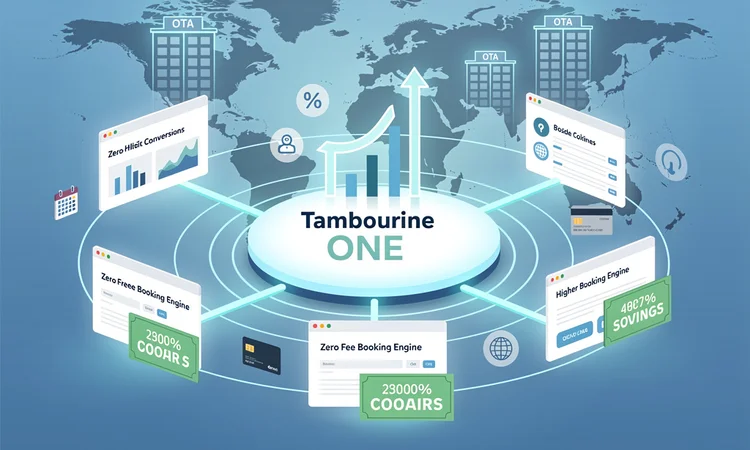
In a bold move to reshape hotel direct bookings, Tambourine, the Fort Lauderdale-based leader in hospitality marketing technology, unveiled Tambourine One on January 22, 2026. This all-in-one platform fuses enterprise-grade website design with a zero-transaction-fee booking engine, aiming to slash costs and boost conversions for hotels worldwide. Trusted by brands across more than 50 countries, Tambourine positions the product as a game-changer amid rising OTA commissions and fragmented tech stacks.

“With Tambourine One, we remove friction at every turn, helping more travelers book in fewer steps,” said Mekell Barker , SVP of Account Service, Hotels at Tambourine, in the launch announcement. The platform eliminates monthly fees on room bookings, a pain point for operators long reliant on third-party engines charging 1-3% per transaction. Existing clients upgrade free, unlocking thousands in monthly savings by ditching add-ons like personalization tools or accessibility services.

Core Features Packed In

Tambourine One bundles high-value tools natively: Google Pay and Apple Pay for mobile wallets, room-and-air packaging rivaling OTAs, AI-powered CMS for front-end edits, native video embeds, travel insurance upsells, and full indemnification against website accessibility lawsuits. Unlimited updates mean no hourly designer fees, while personalization replaces clunky plugins. These address common drop-offs, where mobile users abandon 70% of carts due to payment hurdles, per industry benchmarks.

The unified experience streamlines the path from discovery to confirmation, critical as direct channels now claim 40% of U.S. hotel revenue, up from 30% pre-pandemic. Hotels gain OTA-competitive bundles without vendor sprawl, reducing monthly tech spend from $5,000+ to a flat model.

Roots in Strategic Acquisition

Tambourine One builds directly on the 2024 acquisition of ReservHotel, the CALA region’s top reservation platform serving 500+ resorts. “This acquisition is the inevitable next step in our journey,” CEO Rafael Cardozo stated then, emphasizing frictionless design. Reserv’s air-packaging tech—yielding <5% cancellations—and call centers with 68% new-booking conversions now power One’s engine, extending Tambourine’s websites into full reservations.

Post-acquisition innovations like Encore, a 2025 UI overhaul for Reserv by Tambourine, previewed the seamless interface now central to One. This evolution counters OTA dominance, where Expedia and Booking Holdings pocketed $15 billion in commissions last year.

Cost Savings Hit Hard

Operators face OTA fees averaging 15-20%, eroding margins amid 2026’s projected 4% RevPAR growth. Tambourine One’s zero-fee model, per the company press page , delivers immediate ROI: one mid-size hotel saves $24,000 annually on 10,000 bookings at 2% avoided fees. Bundled features cut $2,000-10,000 in extras, with dedicated onboarding ensuring 30-day launches.

Tambourine’s service—real hospitality pros, not devs—handles optimization, echoing successes like Settlers Hospitality’s nine-site rollout in January 2026. Clients like Fairmont and Lotte hotels have seen triple-digit ROAS from prior platforms, MediaBoom reports .

Industry Execution Edge

Beyond tech, Tambourine pairs One with its Symphony platform for media, metasearch, and CRM. Call centers recover 30% of abandons, while GDS/OTA parity prevents parity disputes. Accessibility built-in dodges $50,000+ ADA suits plaguing 20% of U.S. hotels yearly.

As independents—80% of Tambourine’s base—battle chains’ loyalty programs, One’s personalization and upsells level the field. Hotel Tech Report notes Tambourine’s CMS enables effortless updates, though some reviews flag post-onboarding support dips.

Path Forward for Operators

Dedicated teams guide migrations, with no contracts or upfronts aligning incentives. Early adopters target 20% direct booking lifts, per Tambourine’s benchmarks. In a market where 80% of bookings start online, One’s mobile-first design—optimized for air bundles—positions hotels to recapture OTA share. With X buzz limited to the Breaking Travel News post , word spreads via industry channels like Morningstar and PRNewswire.

Tambourine’s 30-year track record, from print to AI CMS, underscores execution. As Rafael Cardozo told Hotel Management Network , it’s about “reimagining the entire hotel path to purchase.” For insiders, Tambourine One isn’t just tech—it’s a profitability engine.

About the Author

Roman Grant
Roman Grant

Roman Grant is a journalist who focuses on AI deployment. They work through comparative reviews and hands‑on testing to make complex topics approachable. They often cover how organizations respond to change, from process redesign to technology adoption. They are known for dissecting tools and strategies that improve execution without adding complexity. They maintain a balanced tone, separating speculation from evidence. They value transparent sourcing and prefer primary data when it is available. They look for overlooked details that differentiate sustainable success from short‑term wins. They also highlight cultural factors that determine whether change sticks. They explore how policies, markets, and infrastructure intersect to create second‑order effects. Their coverage includes guidance for teams under resource or time constraints. They frequently compare approaches across industries to surface patterns that travel well. A recurring theme in their writing is how teams build repeatable systems and measure impact over time. They watch the policy landscape closely when it affects product strategy. Their work aims to be useful first, timely second.

Comments

Join the discussion and share your thoughts.

No comments yet. Be the first to comment.

Leave a Reply

Your email address will not be published.

Related Posts

Atlantic’s $1.2 Billion Staffing Power Play: F1 Tech Talent Fuels Transatlantic Surge

Atlantic’s $1.2 Billion Staffing Power Play: F1 Tech Talent Fuels Transatlantic Surge

Atlantic International Corp. acquires Circle8 Group in an all-stock deal, creating a $1.2 billion global staffing platform blending U.S. industrial and European IT talent. Circle8's Aston Martin F1 partnership highlights its elite capabilities amid cross-selling potential.

Posted on: by Liam Price
Bots at Work: Service Robotics’ $500 Billion Surge Reshapes Labor Markets

Bots at Work: Service Robotics’ $500 Billion Surge Reshapes Labor Markets

Service robotics rockets toward $498 billion by 2033 at 37% CAGR, automating logistics, healthcare, and hospitality amid AI advances and labor crunches. Deals like Serve's Diligent buy propel indoor expansions.

Posted on: by Layla Reed
Aspire-Deel Tie-Up Reshapes Global Hiring for Fintech Startups

Aspire-Deel Tie-Up Reshapes Global Hiring for Fintech Startups

Aspire integrates Deel's EOR services for seamless global hiring and finance management, targeting startups scaling internationally. The partnership addresses compliance hurdles, offering unified insights into workforce costs and cash flow.

Business
Deel’s Record-Breaking Hiring Spectacle: AI-Powered Push Reshapes Global Talent Wars

Deel’s Record-Breaking Hiring Spectacle: AI-Powered Push Reshapes Global Talent Wars

Deel shattered records with 6,848 attendees at its largest online hiring event, blending AI tools and global reach to fill 300+ sales roles. Amid growth to $17.3 billion valuation, the feat highlights innovations in HR and payroll but sparks debate on stunt versus substance.

Business
Deel’s $17 Billion Sprint: From Y Combinator to Global Payroll Powerhouse

Deel’s $17 Billion Sprint: From Y Combinator to Global Payroll Powerhouse

Deel rocketed to a $17.3 billion valuation in seven years by pioneering owned global payroll infrastructure, processing $22 billion annually for 37,000 firms. Amid IPO prep and DOJ scrutiny, COO Dan Westgarth reveals elite ops driving $1 billion revenue.

Business
HR’s AI Superagent Revolution: Reinventing the Workforce Engine

HR’s AI Superagent Revolution: Reinventing the Workforce Engine

Enterprise AI Superagents ignite HR's biggest transformation in decades, automating 30-40% of jobs while birthing full-stack roles and skills-first strategies. Josh Bersin leads the charge amid bias risks and tech trends reshaping hiring, experience, and leadership.

Business
AI’s HR Reckoning: 10 Pivotal Shifts Reshaping Workforce Strategies in 2026

AI’s HR Reckoning: 10 Pivotal Shifts Reshaping Workforce Strategies in 2026

As AI propels organizations into hybrid human-machine teams, HR must master fluency screening, skills-based shifts and agentic governance to thrive amid 2026's disruptions, blending tech efficiency with human resilience.

Business
The Upselling Paradox: How Retailers Walk the Tightrope Between Revenue Growth and Consumer Trust

The Upselling Paradox: How Retailers Walk the Tightrope Between Revenue Growth and Consumer Trust

New research reveals upselling's hidden risks as retailers balance revenue growth with customer trust. While upselling can boost transaction values by 10-30%, approximately 23% of consumers experience post-purchase regret, potentially damaging long-term profitability and brand reputation in an increasingly skeptical marketplace.

Business
Chrome Extensions’ Silent Siege on Enterprise HR Crown Jewels

Chrome Extensions’ Silent Siege on Enterprise HR Crown Jewels

Five malicious Chrome extensions hijacked sessions on Workday, NetSuite, and SAP SuccessFactors, stealing cookies, blocking admin pages, and enabling takeovers. Socket's discovery prompted Google takedowns after 2,300 installs, exposing enterprise browser risks.

Business
AI Proficiency Divide: HR’s Mounting Crisis

AI Proficiency Divide: HR’s Mounting Crisis

Corporate AI adoption surges, but superficial employee use creates a proficiency chasm now demanding HR intervention through targeted training, outcome metrics, and equity for overlooked workers.

Business