
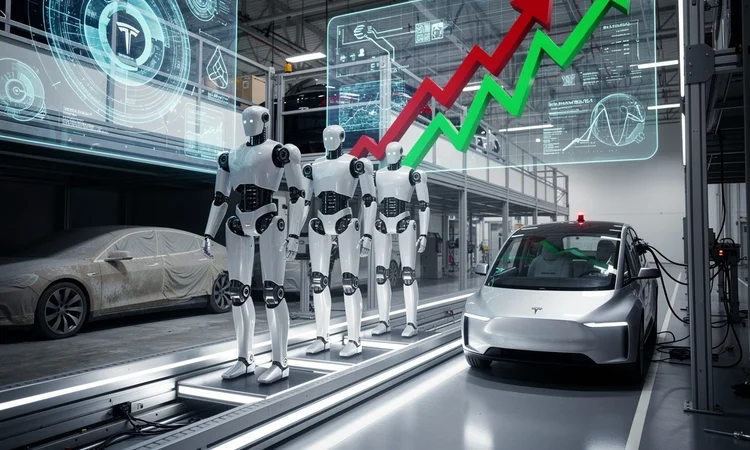
Tesla Inc. unveiled a staggering $20 billion capital spending blueprint for 2026 during its fourth-quarter earnings call on January 28, 2026, marking a seismic pivot from electric vehicles to artificial intelligence, robotics and autonomy. Chief Executive Elon Musk described the year ahead as "a very big capex year," with investments flooding into factories for Cybercab robotaxis, Optimus humanoid robots, Semi trucks, battery refineries and AI infrastructure. This surge, more than double the $8.6 billion spent in 2025, underscores a bold reconfiguration amid slumping auto sales.
CFO Vaibhav Taneja detailed the allocations across six key facilities: a lithium refinery, lithium iron phosphate battery plant, Cybercab production line, Semi truck factory, a new Megafactory and an Optimus plant. "The $20 billion does not include plans for a ‘Tesla TeraFab’" chip fabrication facility or domestic solar cell manufacturing, Musk noted, signaling even grander ambitions. Tesla holds over $44 billion in cash and investments to fund the push, though Taneja hinted at potential debt financing for extended projects. ( CNBC )
Tesla Ditches Legacy Models for Robot Lines
The starkest symbol of transformation: Tesla will cease production of Model S sedans and Model X SUVs next quarter, repurposing Fremont, California factory lines for Optimus robots with capacity targeting one million units annually. These legacy models, less than 3% of 2025 deliveries, "marks the symbolic baton pass" into physical AI, per Barclays analysts. Musk affirmed on X that higher-volume Optimus output would occur at the Texas Gigafactory. ( Bloomberg )
Analysts at Canaccord Genuity captured the moment: "Forget the Tesla you knew… The Tesla of yesterday is gone. We believe Elon Musk has reached a definitive ‘burn the ships’ inflection point — a total commitment to a vision that leaves no room for retreat." They slapped a buy rating on the stock, viewing the shift as irreversible. Barclays concurred: "It’s more than abundantly clear now that Tesla is not an auto company." ( CNBC )
Revenue Slump Forces the Reckoning
Tesla’s automotive revenue, 70% of its business, plunged 10% in 2025 to mark the first annual total revenue drop on record, overtaken globally by China’s BYD amid fierce competition from Volkswagen and BMW in Europe. Q4 earnings per share hit $0.50, topping estimates of $0.45, with revenue at $24.9 billion versus $24.79 billion expected, but full-year revenue fell 3% to $98.4 billion. Automotive gross margins excluding credits climbed to 17.9% despite a 16% delivery drop. ( Reuters )
Energy storage shone brightly, with revenue up 26.6% to $12.8 billion, bolstered by Megapack sales including $430 million to Musk’s xAI. Full Self-Driving subscriptions reached 1.1 million, growing 38% year-over-year and outpacing vehicle deliveries at 22%. Yet, free cash flow dipped to $1.4 billion as spending accelerated. ( The Guardian )
Optimus: Musk’s $25 Trillion Moonshot
Musk envisions Optimus, still in early R&D with no material factory deployment, as Tesla’s value driver, claiming in 2024 it could balloon the company to $25 trillion from $1.4 trillion today and that 80% of value will stem from robots by 2025. Production ramps late 2026, with public sales eyed for 2027. "We’re still very much at the early stages of Optimus," Musk admitted, converting Fremont lines to chase that scale. Zacks’ Andrew Rocco called the capex "necessary spending" to train AI optimally, boosting confidence in timelines. ( TipRanks )
Tesla announced a $2 billion investment in xAI—part of its $20 billion financing round with Nvidia and Cisco—to bolster AI for physical applications, following a failed November shareholder vote but now formalized. This "framework agreement" deepens Musk’s empire ties, with Tesla selling Megapacks to xAI. Musk stressed chip self-reliance: suppliers like Samsung, TSMC and Micron fall short, prompting TeraFab plans in 3-4 years for geopolitical security. "We’re going to be paranoid," he said. ( Los Angeles Times )
Robotaxi Expansion Amid Regulatory Hurdles
Robotaxi pilots run in Austin—now unsupervised—and San Francisco with drivers, surpassing 500 vehicles. Musk projects doubling monthly, expanding to seven U.S. markets like Dallas, Houston and Phoenix in H1 2026. Cybercab production starts April 2026 on a slow S-curve before surging. FSD hit unsupervised status in Austin, with 1.1 million subscribers fueling recurring revenue tied to Musk’s compensation. ( Teslarati )
"We’re really moving into a future that is based on autonomy," Musk declared, though history shows missed deadlines like 50% U.S. robotaxi coverage by end-2025. Competition looms: Alphabet’s Waymo scales U.S. robotaxis, Baidu in China, while Apptronik, Boston Dynamics challenge Optimus domestically and Unitree abroad. ( CNBC )
Wall Street’s Split Verdict
Shares fell 3.5% to $417.89 post-earnings, down 7% in January, reflecting capex shock—nearly double Wall Street’s $11 billion forecast. UBS slapped a sell rating at $352, forecasting $6 billion cash burn and "cash burning mode." Morgan Stanley held equal weight at $415, noting $8 billion burn; BNP Paribas questioned sustainability versus Mag 7 peers. Canaccord urged buying on the vision. ( TheStreet )
Musk framed urgency: projects stem from "desperation," not leisure, amid EV headwinds like tariffs and a "consumer credit cliff." Backlogs grew, with record deliveries in Malaysia, Norway and others. Analysts like William Blair’s Jed Dorsheimer highlighted FSD’s outperformance. Tesla’s valuation, rivaling tech giants despite EV reliance, hinges on AI delivery. ( Yahoo Finance )
Factory Frenzy and Supply Chain Paranoia
Capex fuels expansions at half a dozen plants, including cathode and lithium refining—Musk called these "very hard to build." Energy growth persists with Houston Megafactory megablock production. The TeraFab eyes logic, memory and packaging to insulate against disruptions. Musk’s political distractions and rhetoric drew sales blame in Europe, down 27.8%. ( BNN Bloomberg )
Tesla’s Q4 beat masked annual woes: profits down 46%, loyalty slipping to third per LexisNexis. Yet, margins improved, FSD subscriptions boomed, and autonomy pilots advanced. Musk’s "infinite money glitch" Optimus promises poverty’s end, but unproven tech demands proof amid rivals. The $20 billion bet positions Tesla as AI vanguard—or cautionary cash-burn tale. ( NPR )


Leave a Reply
Your email address will not be published.