
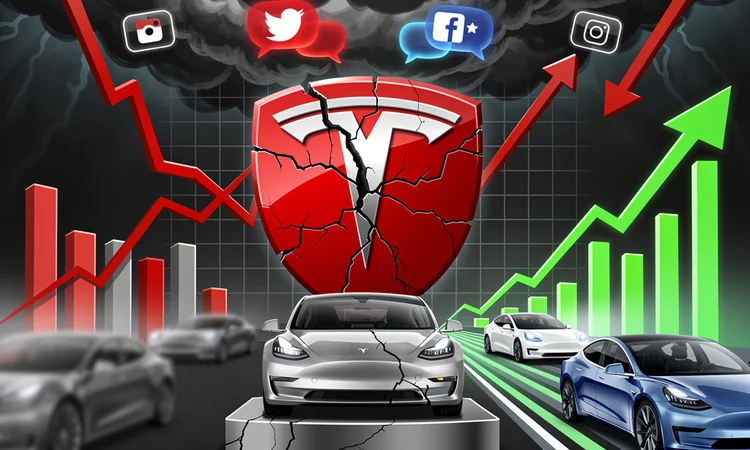
Tesla Inc. finds itself in an unprecedented crisis, one entirely of its own making. The electric vehicle pioneer that once commanded fierce customer loyalty and premium pricing power is now hemorrhaging market share and brand equity at an alarming rate. The culprit isn’t increased competition, manufacturing challenges, or technological shortcomings—it’s the increasingly polarizing political activism of CEO Elon Musk, whose transformation from tech visionary to culture warrior has sent shockwaves through Tesla’s core customer base.
According to Electrek , Tesla is “committing automotive suicide” through a series of self-inflicted wounds that have alienated the very consumers who made the company successful. The publication notes that Tesla’s brand perception has deteriorated dramatically among its traditional customer base—educated, environmentally conscious consumers who lean progressive politically. This demographic shift isn’t abstract; it’s showing up in sales data, with Tesla experiencing its first year-over-year delivery decline in over a decade during the fourth quarter of 2024.
The numbers tell a stark story. Tesla delivered approximately 1.79 million vehicles in 2024, falling short of analyst expectations and representing minimal growth compared to 2023. More troubling for investors, the company’s market share in the crucial U.S. electric vehicle market has plummeted from over 60% in early 2023 to below 50% by late 2024, according to industry tracking data. Meanwhile, competitors like Hyundai, Kia, Ford, and General Motors have steadily gained ground, capitalizing on Tesla’s self-inflicted brand damage.
The Political Miscalculation That Changed Everything
Elon Musk’s political evolution has been swift and dramatic. Once viewed as a relatively apolitical entrepreneur focused on innovation and sustainability, Musk has increasingly embraced controversial right-wing political positions and figures. His acquisition of Twitter, rebranded as X, and subsequent transformation of the platform into what critics describe as a megaphone for conservative talking points marked a turning point. His explicit endorsement of political candidates and amplification of conspiracy theories have created a toxic association for a brand that previously symbolized forward-thinking environmental consciousness.
The impact on consumer sentiment has been measurable and severe. Morning Consult’s brand tracking data showed Tesla’s net favorability among Democrats plummeting by more than 30 percentage points between late 2022 and late 2024. Among Republicans, favorability increased modestly, but not nearly enough to offset losses in Tesla’s core market. This represents a catastrophic miscalculation: Tesla’s traditional buyers—affluent, educated, environmentally conscious consumers—skew heavily Democratic, while the Republican-leaning consumers Musk appears to be courting have historically shown less interest in electric vehicles and often cannot afford Tesla’s premium pricing.
The Competitive Wolves Circle
Tesla’s competitors have wasted no time exploiting the opening. Legacy automakers and new EV startups alike are targeting disaffected Tesla customers with increasingly compelling alternatives. Hyundai’s Ioniq line, Kia’s EV6 and EV9, Ford’s Mustang Mach-E and F-150 Lightning, and General Motors’ expanding Ultium platform vehicles offer competitive range, features, and pricing without the political baggage now attached to Tesla ownership.
The competitive pressure extends beyond traditional metrics. Where Tesla once enjoyed a multi-year technological lead in battery efficiency, charging infrastructure, and autonomous driving capabilities, that gap has narrowed considerably. Ford and General Motors have secured access to Tesla’s Supercharger network, eliminating one of Tesla’s key competitive moats. Meanwhile, companies like Mercedes-Benz and BMW have achieved Level 3 autonomous driving certification in certain markets, matching or exceeding Tesla’s Full Self-Driving capabilities in real-world regulatory approval.
The Dealer Network Advantage Emerges
Tesla’s direct-to-consumer sales model, once hailed as revolutionary, is now revealing weaknesses as competitors leverage their traditional dealer networks. When a Tesla owner has a service issue or collision repair need, they often face weeks-long waits and must travel significant distances to reach a Tesla service center. Meanwhile, buyers of competing EVs from established manufacturers can visit local dealerships for immediate service, often receiving loaner vehicles and more personalized attention.
This service gap has become particularly apparent as Tesla’s vehicle fleet ages and requires more maintenance. Online forums and social media are filled with frustrated Tesla owners sharing horror stories of poor service experiences, months-long waits for parts, and inadequate communication from the company. These service nightmares, combined with Musk’s political activities, have created a perfect storm of customer dissatisfaction that’s driving defections to competitors.
The Premium Brand Problem
Tesla built its business on premium pricing justified by technological superiority and aspirational brand value. Owners paid $50,000 to $100,000 or more not just for an electric vehicle, but for membership in an exclusive club of forward-thinking early adopters. That aspirational value has evaporated for many consumers who now view Tesla ownership as a political statement they don’t want to make.
The brand damage extends beyond politics. Musk’s erratic behavior on social media, his public feuds with journalists and critics, and his increasingly bizarre public statements have made Tesla ownership uncomfortable for many professionals who worry about what their vehicle choice signals to colleagues, clients, and communities. In affluent coastal markets that once represented Tesla’s strongholds, anecdotal reports suggest that Tesla vehicles have become less common in corporate parking lots and upscale neighborhoods.
The China Challenge Intensifies
Tesla’s troubles aren’t confined to the United States. In China, the world’s largest EV market and a crucial profit center for Tesla, domestic competitors led by BYD have surged past Tesla in sales volume. BYD sold over 3 million new energy vehicles in 2024, dwarfing Tesla’s China deliveries. Chinese consumers have shown they’re not particularly attached to the Tesla brand, viewing it as just one option among many increasingly sophisticated domestic alternatives that often cost significantly less.
The geopolitical tensions between the United States and China add another layer of risk to Tesla’s China operations. As Musk has cultivated closer ties with certain U.S. political figures, his ability to navigate the complex relationship between Washington and Beijing becomes more precarious. Tesla’s Shanghai factory, which produces roughly half of the company’s global output, represents both a tremendous asset and a significant vulnerability should U.S.-China relations deteriorate further.
The Innovation Stagnation
Beyond political and brand challenges, Tesla faces questions about its product pipeline and innovation trajectory. The long-promised Cybertruck, finally delivered in limited numbers in late 2023 and throughout 2024, has proven polarizing in design and plagued by quality issues. The vehicle’s unconventional styling and reported problems with fit, finish, and functionality have generated negative publicity rather than the positive buzz Tesla once routinely commanded.
More concerning, Tesla’s core Model 3 and Model Y vehicles are aging without significant updates. While competitors introduce fresh designs with the latest technology, Tesla continues selling vehicles with fundamentally the same exterior designs introduced years ago. The promised $25,000 affordable Tesla remains perpetually “coming soon,” while Chinese competitors already sell compelling EVs at that price point in their home market. The much-hyped robotaxi initiative, which Musk has repeatedly promised would revolutionize transportation and justify Tesla’s valuation, continues to face regulatory hurdles and technological limitations that make near-term deployment unlikely.
The Financial Implications Mount
Wall Street has begun reassessing Tesla’s premium valuation in light of these challenges. For years, Tesla traded at price-to-earnings multiples far exceeding traditional automakers, justified by growth expectations and the promise of future autonomous vehicle and energy businesses. As growth stalls and competitive pressures intensify, that valuation premium looks increasingly difficult to defend.
Analysts note that Tesla’s automotive gross margins have compressed as the company has resorted to price cuts to stimulate demand. The price reductions, while boosting short-term volume, undermine the premium brand positioning and reduce profitability per vehicle. Tesla’s energy storage and solar businesses, while growing, remain too small to offset automotive challenges. The company’s artificial intelligence and robotics initiatives, including the Optimus humanoid robot, are interesting but years away from meaningful revenue contribution.
Can Tesla Recover?
The question facing Tesla investors, employees, and observers is whether the company can reverse its decline. The path forward is clear but politically unpalatable for Musk: he would need to step back from controversial political activism, focus on product development and customer service, and work to rebuild trust with Tesla’s traditional customer base. Some corporate governance experts suggest that Tesla’s board should consider whether Musk’s political activities constitute a breach of fiduciary duty to shareholders, given the demonstrable damage to brand value and sales.
However, Musk shows no signs of moderating his behavior. If anything, his political engagement has intensified, suggesting he values his platform and influence more than Tesla’s commercial success. This creates a seemingly intractable problem: the CEO whose vision and determination built Tesla into a revolutionary force is now the primary obstacle to the company’s continued success. Without significant changes in leadership approach or structure, Tesla appears destined to continue its transformation from industry disruptor to cautionary tale about the dangers of letting personal politics override business judgment.
The automotive industry has seen dominant players fall before. Packard, once America’s premier luxury brand, disappeared. General Motors, once seemingly invincible, required a government bailout. Tesla’s advantages in battery technology, manufacturing scale, and charging infrastructure provide some cushion against complete collapse. But the company’s trajectory is unmistakably negative, and the window for course correction may be closing. For an industry that moves in product cycles measured in years, not quarters, the decisions Tesla makes—or fails to make—in 2025 will likely determine whether it remains a major player or becomes a historical footnote about promise squandered.


Leave a Reply
Your email address will not be published.