
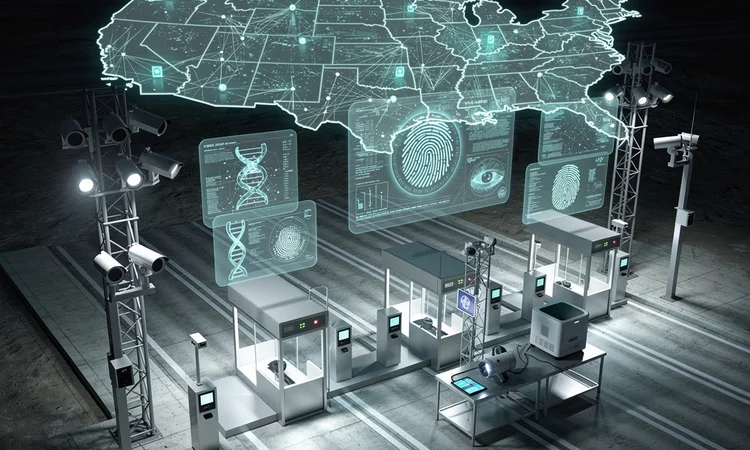
WASHINGTON—In detention facilities along the U.S. border and in consular offices around the globe, a quiet but profound revolution in government surveillance is taking place. The long-standing practice of collecting fingerprints from foreign nationals is being rapidly superseded by a far more intrusive dragnet, one that seeks to capture the very essence of an individual’s biological and digital identity. The U.S. government is systematically expanding its authority to demand DNA samples, scan faces into massive databases, and scrutinize years of social media history from millions of people, creating a formidable, high-tech vetting infrastructure that is blurring the lines between immigration, law enforcement, and national security.
This escalation began to take formal shape during the Trump administration, which initiated some of the most sweeping changes to data collection policies in decades. In 2019, the Department of Justice proposed a rule to dramatically expand the government’s authority to collect DNA from nearly all non-U.S. citizens detained by federal authorities, including asylum seekers and, in some cases, even legal permanent residents pending hearings. As detailed by Privacy International at the time, the stated goal was to populate the FBI’s Combined DNA Index System (CODIS), a criminal database, with genetic information from a vast pool of migrants, effectively treating them as criminal suspects by default.
From Fingerprints to Genetic Blueprints
The policy was finalized and implemented in 2020, mandating that Department of Homeland Security (DHS) components like Customs and Border Protection (CBP) and Immigration and Customs Enforcement (ICE) collect DNA via cheek swabs from individuals in their custody. The move was immediately challenged by civil rights groups, who argued it violated the Fourth Amendment and fundamental privacy rights. In a lawsuit, the American Civil Liberties Union asserted that the rule authorizes “suspicionless collection and storage of DNA of an enormous population of non-citizens,” creating a massive genetic database ripe for misuse. Despite the legal challenges, the program has continued, embedding genetic surveillance into the standard operating procedure of U.S. immigration enforcement.
This collection of biological data represents a monumental shift. Unlike a fingerprint, a DNA sample contains a wealth of deeply personal information, from familial relationships to predispositions for medical conditions. The Electronic Frontier Foundation has warned that storing this sensitive data in government databases, where it can be shared across agencies, creates a permanent digital shadow that can follow an individual for life. The potential for error, mission creep, and discriminatory use is immense, yet the policy has remained largely intact, signaling a bipartisan acceptance of more invasive biometric collection in the name of security.
Algorithmic Vetting and Its Perils
Parallel to the expansion of biological data collection, the government has pushed deeper into the digital lives of those seeking to enter the country. The State Department now requires nearly all visa applicants—amounting to roughly 15 million people per year—to register their social media handles used over the previous five years on a list of 20 platforms. This information is used by consular officials to scrutinize applicants’ online activity for potential security threats, a process that is often opaque and reliant on algorithms to flag concerning content. The policy effectively makes an individual’s online expression—their opinions, associations, and even their humor—a factor in their eligibility to travel to the United States.
The efficacy and fairness of such screening are highly questionable. A report from the Brennan Center for Justice at NYU School of Law argues that automated and manual social media screening is not only ineffective at identifying credible threats but is also dangerously prone to bias. Algorithms can easily misinterpret slang, sarcasm, or religious expression, leading to wrongful visa denials. Furthermore, the knowledge that online activity is being monitored can create a significant chilling effect on the free speech of millions of people abroad who may have family, business, or academic ties to the U.S.
A Centralized System for a Surveillance Future
The vast streams of biometric and biographical data being collected are funneled into an ever-growing technological backbone managed by DHS. The centerpiece of this infrastructure is the Homeland Security Advanced Recognition Technology (HART) system, a massive cloud-based database designed to replace and expand upon the legacy IDENT system. HART is engineered to store and match a wide array of biometric identifiers, including fingerprints, facial images, iris scans, and DNA profiles, linking them to an individual’s personal information. According to an analysis by the Electronic Privacy Information Center (EPIC) , HART will be one of the largest biometric databases in the world, capable of storing profiles on hundreds of millions of people, including U.S. citizens.
This centralized repository is being fed by a rapidly expanding network of collection points. One of the most visible is the Traveler Verification Service (TVS), the facial recognition system deployed by CBP at airports across the country for “biometric entry-exit.” Travelers, including American citizens, are increasingly required to pose for a photo that is matched against a government database to verify their identity. While DHS promotes the system as a measure to increase efficiency and security, privacy advocates warn it is normalizing facial scanning and creating a vast infrastructure for tracking people’s movements, a concern echoed by lawmakers questioning the program’s unchecked expansion and lack of clear regulations.
Policy Continuation and Technological Acceleration
While many of these programs were initiated or accelerated under the Trump administration, they have largely continued and, in some cases, expanded under President Biden. The current administration has defended the DNA collection rule in court and has aggressively pushed the use of new technologies at the border. A prime example is the CBP One mobile app, which asylum seekers are now largely required to use to schedule appointments at ports of entry. The app utilizes facial recognition technology and geolocation tracking, conditioning access to the asylum system on the use of a government surveillance tool.
The Associated Press reported that the app’s rollout has been plagued by technical glitches and equity concerns, with darker-skinned individuals reporting problems with the facial recognition feature. This highlights a persistent trend: the drive to deploy advanced surveillance technology often outpaces considerations of its accuracy, fairness, and civil liberties implications. The momentum is fueled by a powerful combination of national security imperatives and a multi-billion dollar government contracting industry that has a vested interest in the continued expansion of biometric systems.
The Shifting Balance of Power and Privacy
The United States is constructing a digital border that is far more extensive and intrusive than any physical wall. This new paradigm is built on the premise that security is best achieved through the mass collection and algorithmic analysis of personal data. It shifts the focus of immigration vetting from verifying identity to predicting risk, a speculative endeavor that subjects millions to a level of scrutiny that is both invasive and often unaccountable. Individuals are increasingly judged not just by their official documents and interview statements, but by the invisible data trails they leave in their biological code and on the internet.
The long-term consequences of this shift are still unfolding, but they point toward a future where the distinction between foreign and domestic surveillance erodes and where privacy is treated as a luxury rather than a right. As these massive databases become interconnected and the technologies more powerful, the infrastructure being built today to screen non-citizens could easily be repurposed. The ongoing legal and legislative battles over these programs will determine not only the future of immigration policy but also the fundamental relationship between the individual and the state in an age of ubiquitous data.


Leave a Reply
Your email address will not be published.