
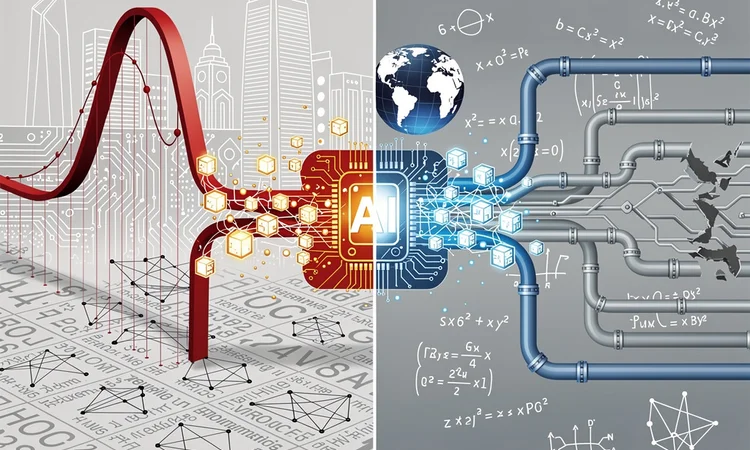
While American technology executives debate the merits of remote work and diversity initiatives, China has been executing a multi-generational strategy to dominate artificial intelligence through a largely unknown educational pipeline that has been identifying and cultivating mathematical prodigies for more than four decades. This systematic approach to talent development, operating far from Western media scrutiny, is now producing the technical workforce driving China’s challenge to U.S. technological supremacy.
According to Slashdot , China’s specialized education system for gifted students has created a conveyor belt of elite mathematicians and computer scientists who are now staffing the country’s most advanced AI laboratories. This infrastructure, built over decades with little fanfare, represents a strategic investment in human capital that is fundamentally different from Western approaches to STEM education and talent development.
The program’s origins trace back to the late 1970s, when China established specialized schools and classes designed to identify students with exceptional mathematical abilities as early as elementary school. These students are then funneled through an increasingly rigorous curriculum that emphasizes deep theoretical knowledge, problem-solving under pressure, and competition on the international stage. Unlike American gifted programs, which often prioritize well-rounded development, China’s system creates hyper-specialized technical experts.
The Mathematics Olympiad Machine and Its AI Dividends
China’s dominance in international mathematics competitions provides a window into the scale and effectiveness of this talent pipeline. The country has won the International Mathematical Olympiad team competition more than any other nation over the past two decades, and many of these competitors have gone on to lead AI research teams at companies like ByteDance, Alibaba, and Huawei. The connection between early mathematical prowess and later AI innovation is not coincidental—it reflects deliberate planning by Chinese education authorities.
The specialized schools, known as “key schools” or “experimental schools,” operate with substantially more resources than regular Chinese schools. Students selected for these programs often begin intensive mathematical training in middle school, studying topics that American students might not encounter until graduate school. This early exposure to advanced mathematics provides a foundation that proves invaluable when these students later transition to machine learning and AI research, fields that are fundamentally mathematical in nature.
From Classroom to Cutting-Edge Research Labs
The pipeline doesn’t end with undergraduate education. Many graduates of China’s elite STEM programs pursue advanced degrees at top American universities, where they absorb cutting-edge research methodologies before returning to China to apply their knowledge. This pattern has created what some Western analysts call a “knowledge arbitrage” system, where China benefits from American research infrastructure while building parallel capabilities at home.
Recent data suggests this strategy is paying dividends. Chinese researchers now publish more AI research papers than their American counterparts, and Chinese tech companies are competing directly with Silicon Valley giants in areas like natural language processing, computer vision, and autonomous systems. The technical workforce enabling this competition was largely educated in the specialized schools established decades ago, demonstrating the long-term payoff of China’s educational investments.
The Scale Advantage: Numbers That American Programs Cannot Match
The sheer scale of China’s talent development system dwarfs comparable American efforts. While the United States has selective programs like the Davidson Academy or state-level governor’s schools for gifted students, these serve thousands of students annually. China’s system, by contrast, funnels hundreds of thousands of students through specialized STEM tracks each year, creating a talent pool that is orders of magnitude larger than what Western countries produce.
This numerical advantage compounds over time. Even if American programs produce students of comparable individual quality, the volume of highly trained technical workers emerging from China’s system creates a significant strategic advantage. In AI development, where progress often depends on having large teams working on incremental improvements, the ability to deploy more qualified researchers can be decisive.
The Cultural Dimension: Competition as Educational Philosophy
Understanding China’s educational pipeline requires grappling with cultural factors that shape how talent is identified and developed. Chinese educational culture places enormous emphasis on competitive examinations and rankings, creating an environment where students are accustomed to intense academic pressure from an early age. This cultural context makes the specialized schools’ demanding curricula more socially acceptable than they might be in Western countries, where concerns about childhood stress and well-being often limit the intensity of academic programs.
The gaokao, China’s notoriously difficult college entrance examination, serves as both a sorting mechanism and a cultural touchstone. Students who excel in this system are celebrated as exemplars of diligence and intelligence, reinforcing social support for intensive academic preparation. This cultural framework enables the specialized schools to push students harder and earlier than would be politically feasible in most Western democracies, where parents and educators often resist academic tracking and intensive specialization for young children.
Government Coordination and Strategic Planning
Unlike American STEM education, which is fragmented across thousands of independent school districts and universities, China’s system benefits from centralized planning and coordination. The Ministry of Education works directly with leading universities and tech companies to align curriculum with national strategic priorities, ensuring that the specialized schools produce graduates with skills that match emerging industry needs.
This coordination extends to research priorities and funding. Chinese AI companies maintain close relationships with the specialized schools and universities, offering internships, funding research projects, and recruiting top graduates. The boundary between academic research and commercial application is more porous than in the United States, allowing for faster translation of theoretical advances into practical applications.
The American Response: Fragmented and Underfunded
American efforts to compete with China’s talent pipeline face structural disadvantages. STEM education in the United States remains chronically underfunded relative to other developed nations, and programs for gifted students are often the first cut during budget crises. Political debates about educational equity sometimes cast specialized programs for high-achieving students as elitist, creating obstacles to expanding such initiatives even when national security interests might argue for doing so.
Furthermore, American culture’s emphasis on well-rounded education and extracurricular activities means that even highly capable students often do not develop the same depth of specialized knowledge as their Chinese counterparts. While this approach may produce more versatile individuals, it can leave American students at a disadvantage in fields like AI that require deep mathematical expertise and intensive focus.
The Retention Challenge: Keeping Talent at Home
Historically, one of America’s great advantages was its ability to attract and retain top international talent, including many graduates of China’s specialized schools. However, this dynamic is shifting. Improved research facilities in China, combined with government incentives and, in some cases, political pressure, are convincing more Chinese-educated scientists to remain in or return to China. Restrictive U.S. immigration policies and growing anti-Chinese sentiment in American politics have accelerated this trend.
The reversal of brain drain has significant implications for the AI competition. Chinese researchers who might once have spent their careers at American universities or tech companies are now building China’s domestic capabilities. This represents a double loss for the United States: not only does America miss out on these individuals’ contributions, but their talents are instead deployed to advance a strategic competitor’s technological capabilities.
Beyond Education: The Ecosystem Advantage
The specialized schools are only one component of a broader ecosystem supporting AI development in China. Government funding for AI research dwarfs American public investment, and Chinese tech companies face fewer regulatory constraints on data collection and algorithm deployment. This enabling environment means that graduates of the specialized schools enter a workforce where they can immediately apply their skills to large-scale problems with access to massive datasets.
Chinese AI researchers also benefit from a different relationship between government, academia, and industry than exists in the United States. Military-civil fusion policies explicitly encourage collaboration across these sectors, allowing AI advances to flow quickly between domains. While this raises ethical concerns from a Western perspective, it creates efficiencies that accelerate technological development and deployment.
Implications for Global Technology Competition
The maturation of China’s decades-old talent pipeline is fundamentally altering the dynamics of global technology competition. The United States can no longer assume that it will maintain indefinite superiority in cutting-edge fields like AI simply by attracting the world’s best and brightest to American shores. China is now producing comparable talent at home, in greater numbers, and increasingly retaining these individuals within its borders.
This shift demands a reconsideration of American strategies for maintaining technological leadership. Incremental improvements to existing programs will likely prove insufficient. Instead, the United States may need to contemplate more fundamental reforms to how it identifies, educates, and deploys technical talent—reforms that would require confronting difficult questions about educational equity, specialization, and the proper balance between individual development and national strategic interests. The quiet success of China’s specialized schools suggests that in the race for AI supremacy, the decisions made in middle school classrooms today will determine which nation leads the technology sector decades hence.


Leave a Reply
Your email address will not be published.