
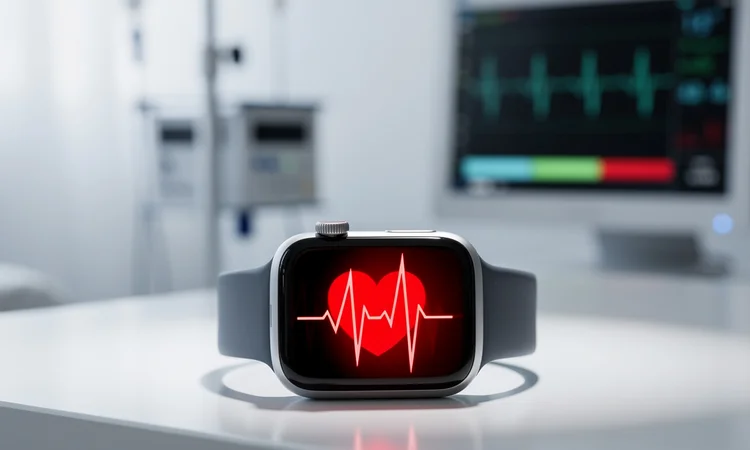
The technology industry has long promised that wearable devices would revolutionize healthcare, transforming smartphones and smartwatches into personal health monitors capable of detecting serious medical conditions before they become critical. For decades, these claims have oscillated between ambitious marketing rhetoric and genuine medical breakthrough. Yet for journalist Pollard, this promise materialized in the most visceral way possible when his Apple Watch detected an abnormal heart rate that led to the discovery of a life-threatening condition requiring immediate surgical intervention.
According to 9to5Mac , Pollard, a political journalist, received a high heart rate notification from his Apple Watch while sitting at his desk. The alert indicated his heart rate had remained elevated above 120 beats per minute for an extended period despite being at rest—a classic warning sign that something was seriously wrong. What followed was a cascade of medical examinations that ultimately revealed a critical health issue requiring immediate attention, transforming Pollard from an observer of technology into a living testament to its potential life-saving capabilities.
The incident raises profound questions about the intersection of consumer technology and medical care, particularly as tech giants like Apple, Samsung, and Fitbit continue expanding their devices’ health monitoring capabilities. These companies are no longer merely selling gadgets; they’re positioning themselves as essential components of preventative healthcare infrastructure, capable of detecting conditions ranging from atrial fibrillation to sleep apnea, often before traditional medical systems would identify them.
The Evolution of Wearable Health Technology Beyond Fitness Tracking
Apple’s journey into serious health monitoring began incrementally, starting with basic fitness tracking features before evolving into FDA-cleared medical device capabilities. The company introduced heart rate notifications in 2018, designed to alert users when their heart rate rises above or falls below a specified threshold while appearing to be inactive for a 10-minute period. This feature operates continuously in the background, requiring no user intervention—a critical design choice that enables detection even when users aren’t actively thinking about their health.
The technology underlying these notifications relies on photoplethysmography, which uses green LED lights paired with light-sensitive photodiodes to detect blood volume changes in the wrist. While this optical heart rate monitoring has limitations compared to medical-grade electrocardiogram equipment, its continuous operation and integration into daily life provide a surveillance capability that traditional medical checkups cannot match. Users visit their doctors perhaps once or twice annually; their Apple Watch monitors them every moment they wear it.
This continuous monitoring capability has generated numerous documented cases of early detection. Medical literature and news reports have chronicled instances where Apple Watch alerts led to the discovery of previously undiagnosed atrial fibrillation, pulmonary embolisms, and other cardiovascular conditions. The Apple Heart Study, a collaboration with Stanford Medicine that enrolled more than 400,000 participants, found that 0.5% of participants received irregular heart rhythm notifications, and of those who subsequently wore an electrocardiogram patch, 34% showed atrial fibrillation.
The Medical Community’s Complicated Relationship With Consumer Health Devices
The medical establishment’s response to consumer health wearables has been decidedly mixed, reflecting both enthusiasm for their potential and concern about their limitations. Cardiologists acknowledge that devices like the Apple Watch can serve as valuable screening tools, particularly for detecting atrial fibrillation in populations that might not otherwise undergo regular cardiac monitoring. The ability to capture heart rhythm data during symptomatic episodes—moments that patients might not experience during scheduled medical appointments—provides clinicians with information that would otherwise remain invisible.
However, physicians also express concerns about false positives, anxiety-inducing alerts, and the medicalization of normal physiological variations. Not every elevated heart rate indicates a medical emergency; anxiety, caffeine consumption, dehydration, and physical activity can all trigger alerts that may send worried users to emergency rooms unnecessarily. This phenomenon, sometimes called the “worried well” problem, raises questions about resource allocation and the psychological impact of constant health surveillance.
The regulatory environment surrounding these devices reflects this tension. The FDA has cleared certain Apple Watch features as medical devices, including its electrocardiogram app and irregular rhythm notification feature, subjecting them to regulatory oversight while allowing them to be marketed directly to consumers without prescriptions. This hybrid status—simultaneously consumer electronics and medical device—creates a unique category that challenges traditional healthcare delivery models.
Personal Health Data and the Privacy Calculus
Pollard experience also illuminates the privacy implications of continuous health monitoring. For the Apple Watch to detect his elevated heart rate, the device necessarily collected, analyzed, and stored intimate physiological data continuously. This surveillance, while potentially life-saving, represents an unprecedented level of bodily monitoring that would have seemed dystopian mere decades ago. The fact that users willingly—even eagerly—adopt such monitoring reflects a fundamental shift in privacy expectations when health benefits are at stake.
Apple has positioned privacy as a competitive advantage, emphasizing that health data remains encrypted and under user control, processed largely on-device rather than transmitted to cloud servers. This approach contrasts with some competitors whose business models depend more heavily on data aggregation and analysis. Yet the broader trend toward continuous health monitoring raises questions that extend beyond any single company’s privacy policies: What happens when insurance companies request this data? Could employers require health monitoring as a condition of employment? How might this information be used in legal proceedings?
The technology industry’s expansion into healthcare also creates new liability questions. If an Apple Watch fails to detect a serious condition, or generates a false negative that provides false reassurance, who bears responsibility? The device’s user agreements contain extensive liability limitations, and Apple consistently emphasizes that its health features are not intended to replace professional medical advice. Yet as these devices become more sophisticated and their health monitoring more central to their value proposition, the line between consumer gadget and medical device continues to blur.
The Economic Implications of Consumer-Driven Health Monitoring
The proliferation of health-monitoring wearables carries significant economic implications for healthcare systems worldwide. Preventative detection of serious conditions before they require emergency intervention could substantially reduce healthcare costs. A heart condition detected early through continuous monitoring might be managed with medication and lifestyle changes; the same condition detected only after a cardiac event might require hospitalization, surgery, and extended recovery—at vastly greater expense.
Healthcare economists have begun studying whether widespread adoption of health wearables could generate measurable improvements in population health outcomes and cost savings. Early research suggests potential benefits, though definitive conclusions remain elusive. The challenge lies in isolating the impact of wearable devices from other variables affecting health outcomes, and in accounting for the costs of false positives and unnecessary medical consultations that these devices might generate.
For technology companies, health features represent both a product differentiator and a pathway to deeper user engagement. A smartwatch purchased primarily for fitness tracking might be replaced when a newer model offers marginal improvements; a device that users credit with saving their lives creates loyalty that transcends typical consumer electronics upgrade cycles. This dynamic helps explain why Apple, Samsung, Google, and other tech giants continue investing heavily in health monitoring capabilities despite regulatory complexity and liability concerns.
The Future of Predictive Health Technology
Pollard experience represents current capabilities, but the trajectory of wearable health technology points toward even more sophisticated monitoring. Companies are developing sensors capable of detecting blood glucose levels non-invasively, monitoring blood pressure continuously, and identifying early signs of infections through changes in body temperature and heart rate variability. Machine learning algorithms analyzing patterns across millions of users could potentially identify health risks before any single symptom becomes apparent.
This future raises both extraordinary opportunities and profound challenges. The potential to detect diseases in their earliest, most treatable stages could revolutionize medicine, shifting emphasis from treatment to prevention. Yet this same capability could exacerbate healthcare inequalities, creating a two-tiered system where those who can afford sophisticated wearables receive early warnings while others rely on traditional reactive care. The devices themselves, typically priced at several hundred dollars, remain inaccessible to many populations that might benefit most from continuous health monitoring.
The integration of artificial intelligence into health monitoring adds another dimension of complexity. As these devices accumulate more data and their algorithms become more sophisticated, they may detect patterns that even trained physicians might miss. Yet algorithmic decision-making in healthcare raises concerns about transparency, bias, and the appropriate role of automated systems in medical care. A device that alerts users to potential health problems must balance sensitivity against specificity—detecting genuine issues without generating excessive false alarms that undermine trust and utility.
Redefining the Doctor-Patient Relationship in the Digital Age
Perhaps most fundamentally, the rise of consumer health wearables is transforming the traditional doctor-patient relationship. Patients increasingly arrive at appointments armed with data from their devices, sometimes knowing more about their day-to-day physiological patterns than their physicians. This shift can empower patients and facilitate more informed discussions, but it can also create tension when patient-generated data conflicts with clinical judgment or when physicians feel pressured to respond to every anomaly detected by consumer devices.
For Pollard, the Apple Watch alert initiated a medical journey that likely saved his life. His experience validates the technology industry’s ambitious claims about wearable health monitoring, providing a concrete example of consumer technology detecting a serious condition that might otherwise have gone unnoticed until it became critical. Yet his story also illustrates that these devices are tools, not replacements for medical care—the watch detected an anomaly, but diagnosis and treatment required traditional medical expertise and intervention.
As wearable health technology continues evolving, cases like Pollard will likely become more common, gradually normalizing the idea that consumer electronics play legitimate roles in healthcare. This evolution challenges existing regulatory frameworks, reimbursement models, and medical practice patterns. The question is no longer whether consumer technology will transform healthcare, but how quickly this transformation will occur and whether healthcare systems can adapt to integrate these new capabilities effectively while addressing the equity, privacy, and quality concerns they raise. For journalists like Pollard who cover technology, the story has become intensely personal—a reminder that the devices they review aren’t merely gadgets, but potentially life-saving medical tools that blur the boundaries between consumer electronics and healthcare in ways that would have seemed impossible just years ago.


Leave a Reply
Your email address will not be published.