
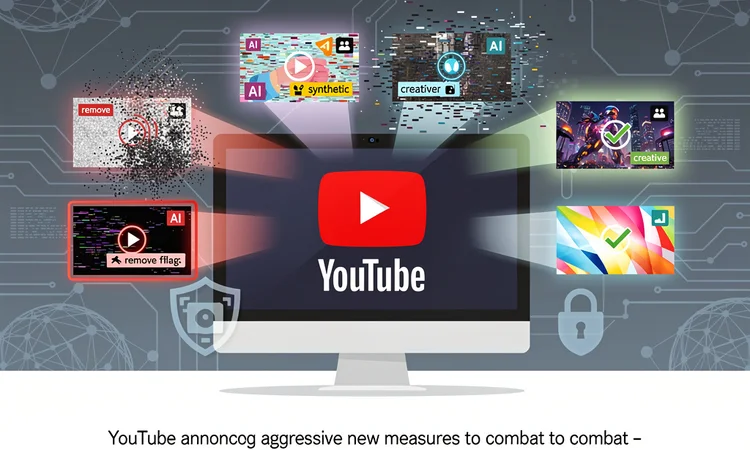
In a significant policy shift that signals mounting concern over artificial intelligence’s impact on digital content quality, YouTube has announced sweeping measures to combat what industry insiders have dubbed “AI slop”—low-quality, machine-generated videos flooding the platform. The move represents one of the most aggressive stances taken by a major social media company against the proliferation of synthetic content, and it arrives at a moment when the boundaries between human creativity and algorithmic output have become increasingly blurred.
According to Android Police , YouTube has confirmed it will implement new detection systems and enforcement mechanisms specifically designed to identify and remove content that meets the criteria for AI-generated material lacking substantial human creative input. The platform’s decision comes after months of creator complaints and viewer frustration over an exponential increase in algorithmically-produced videos that game the recommendation system while offering minimal value to audiences.
The policy change affects multiple content categories, from AI-narrated news summaries to synthetic music compilations and automated video essays. YouTube’s product team has indicated that the new rules will focus on content that demonstrates clear patterns of mass production through AI tools, particularly when such content appears designed primarily to generate ad revenue rather than serve viewer interests. This represents a delicate balancing act for the Google-owned platform, which must distinguish between legitimate uses of AI as a creative tool and exploitative content farming operations.
The Economics Behind the AI Content Explosion
The surge in AI-generated YouTube content stems from a perfect storm of technological advancement and economic incentive. With tools like ChatGPT, Midjourney, and ElevenLabs becoming increasingly accessible and affordable, the barriers to content creation have collapsed. Entrepreneurs discovered they could produce hundreds of videos per day with minimal investment, targeting trending topics and search keywords to capture views and advertising dollars. Some operations reportedly generated thousands of dollars monthly by flooding niche categories with AI-produced material.
Industry analysts estimate that AI-generated content now accounts for a significant percentage of new uploads in certain categories, particularly in educational content, news commentary, and entertainment compilation videos. The economic model proves particularly attractive in developing markets, where the potential earnings from YouTube’s Partner Program represent substantial income. However, this gold rush has created severe quality degradation across the platform, with viewers increasingly encountering repetitive, error-filled, or misleading content that technically violates no existing rules.
Detection Challenges and Technical Implementation
YouTube faces considerable technical hurdles in implementing its anti-AI-slop initiative. Unlike text-based platforms where AI detection tools have matured significantly, identifying synthetic video content requires analyzing multiple dimensions simultaneously: voice patterns, visual consistency, editing rhythms, and content originality. The platform must develop systems sophisticated enough to catch mass-produced AI content while avoiding false positives that might penalize creators who use AI tools legitimately as part of their creative process.
Sources familiar with YouTube’s technical approach indicate the company is developing multi-layered detection systems that examine metadata patterns, upload frequency, content similarity across channels, and behavioral signals that distinguish automated operations from human creators. The system will likely incorporate machine learning models trained on known examples of AI-generated content, combined with heuristic rules that flag suspicious patterns for human review. YouTube has not disclosed specific technical details, likely to prevent bad actors from gaming the detection systems.
Creator Community Response and Concerns
The announcement has generated mixed reactions within YouTube’s creator community. Established content producers have largely welcomed the policy change, arguing that AI-generated spam has degraded search results and recommendation quality, making it harder for human creators to reach audiences. Many creators report that their original content increasingly competes against dozens of AI-generated videos targeting identical keywords, diluting their viewership and revenue.
However, some creators express concern about potential overreach and the difficulty of defining legitimate AI use. Modern content creation frequently involves AI tools for tasks like thumbnail generation, script assistance, translation, and audio enhancement. The fear is that YouTube’s enforcement mechanisms might inadvertently penalize creators who use these tools as productivity enhancers rather than content replacement. The platform has attempted to address these concerns by emphasizing that its focus remains on content that is “substantially” AI-generated with minimal human creative input, though the precise boundaries remain unclear.
Broader Industry Implications and Precedent
YouTube’s policy shift carries implications far beyond its own platform. As one of the internet’s largest content repositories and a trendsetter in digital media policy, YouTube’s actions often influence competitors and establish industry norms. Other platforms have watched the AI content explosion with similar concern but have hesitated to implement aggressive countermeasures, partly due to the technical challenges and partly due to uncertainty about where to draw policy lines.
The move also reflects growing recognition among tech companies that unchecked AI content generation threatens the fundamental value proposition of user-generated content platforms. If audiences cannot trust that content represents genuine human creativity and expertise, engagement metrics suffer, and advertiser confidence erodes. Several major brands have already expressed concerns about their advertisements appearing alongside low-quality AI-generated content, creating financial pressure for platforms to address the issue.
The Human Creativity Premium
YouTube’s policy effectively establishes a “human creativity premium” in its content ecosystem, signaling that authentic human creative input carries value that purely algorithmic production cannot replicate. This philosophical stance represents a notable shift from the platform’s historically neutral approach to content sources. By explicitly devaluing AI-generated material, YouTube makes a statement about the nature of creative work and the role of human authorship in digital media.
This position aligns with broader cultural conversations about AI’s role in creative industries. While AI tools have demonstrated impressive capabilities in generating text, images, and video, questions persist about whether such output constitutes genuine creativity or merely sophisticated pattern matching. YouTube’s policy implicitly answers this question by treating substantial human creative input as a requirement for content legitimacy, not merely a nice-to-have feature.
Enforcement Realities and Gray Zones
The practical implementation of YouTube’s anti-AI-slop measures will likely prove more complex than the policy announcement suggests. Content exists on a spectrum from entirely human-created to fully AI-generated, with vast gray zones in between. A creator might use AI to generate a script outline, write the actual content themselves, use AI for voice synthesis due to speech impediments, and employ AI tools for video editing. Does this constitute AI slop or legitimate creative work?
YouTube will need to develop nuanced enforcement criteria that account for these complexities while remaining practical to implement at scale. The platform processes more than 500 hours of video uploads every minute, making comprehensive human review impossible. Automated systems must therefore bear the primary enforcement burden, with human reviewers handling appeals and edge cases. The accuracy and fairness of these systems will determine whether the policy achieves its goals or creates new problems for legitimate creators.
Economic Disruption and Market Adaptation
The policy change will likely trigger significant economic disruption in the AI content generation industry. Numerous businesses have emerged specifically to help creators produce YouTube content at scale using AI tools, and many individual entrepreneurs have built income streams around mass-producing synthetic videos. These operations will need to adapt or face elimination from the platform, potentially affecting thousands of content producers globally.
However, the policy may also create opportunities for creators who emphasize authentic human creativity and expertise. As AI-generated content becomes less viable, audiences may gravitate toward creators who offer genuine knowledge, unique perspectives, and personal authenticity—qualities that remain difficult for AI to replicate convincingly. This could potentially improve overall content quality and restore some of the platform’s earlier character as a venue for individual creative expression rather than algorithmic content farming.
YouTube’s war on AI slop represents more than a simple content policy update. It reflects fundamental questions about the future of digital media, the value of human creativity, and the role of platforms in shaping content ecosystems. As AI capabilities continue advancing, other platforms will face similar decisions about where to draw lines between acceptable and unacceptable synthetic content. YouTube’s approach, whatever its ultimate success or failure, will provide crucial lessons for an industry grappling with technology that simultaneously enables and threatens the creative communities it serves. The coming months will reveal whether the platform can successfully thread the needle between eliminating exploitative AI content farms and preserving space for legitimate creative uses of AI tools—a balance that will likely define content platform policies for years to come.


Leave a Reply
Your email address will not be published.