







Albertsons’ Add-It Button: Retail Media’s Click-to-Cart Revolution

Emily Scott
Emily Scott

Albertsons Media Collective's Add-It technology enables one-click cart additions from offsite ads, tackling retail media's conversion woes. With expansions to CTV and social planned, it's poised to boost advertiser ROI amid fierce competition.

Albertsons’ Add-It Button: Retail Media’s Click-to-Cart Revolution

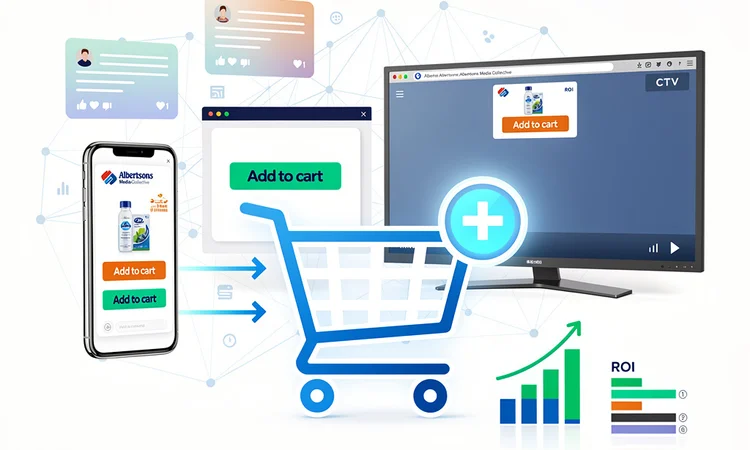
Albertsons Cos. is deploying a new advertising tool called Add-It, designed to bridge the gap between digital impressions and actual purchases in the offsite retail media arena. This beta program, launched by the grocer’s Albertsons Media Collective, allows consumers viewing display ads or shoppable content across the open web to instantly drop products, recipes, coupons, or offers directly into their Albertsons online shopping carts. The move addresses a persistent pain point in retail media networks: the high abandonment rate between ad exposure and checkout.

Retail media spending is exploding, with global projections reaching $184 billion this year and surpassing $300 billion by 2030, according to recent forecasts cited in industry reports. Yet, offsite ads—those running outside a retailer’s owned properties—often fail to convert because shoppers must navigate multiple steps to buy. Add-It aims to slash that friction, transforming passive browsing into immediate action. ‘This is about making media shoppable,’ an Albertsons executive told Adweek .

The technology integrates with Albertsons’ just-for-you personalization engine, which powers tailored shopping experiences across its 2,200-plus stores. Early tests with brands like General Mills have shown promising results, with the grocer reporting streamlined paths to purchase that boost return on ad spend.

Frictionless Path Reshapes Advertiser ROI

At its core, Add-It tackles the ‘cold start’ problem in offsite retail media, where consumers encounter ads on third-party sites without an established shopping session. A single click on the Add-It button authenticates the user via Albertsons’ login and populates their cart, eliminating manual searches and logins. This mirrors innovations like Amazon’s ‘Buy Now’ but extends them to a fragmented web environment.

Albertsons Media Collective positions this as part of a broader ‘frictionless commerce’ strategy. The network, which generated over $1 billion in revenue last year, now extends its closed-loop measurement capabilities to offsite channels. Advertisers gain visibility into how impressions drive incremental sales, a key differentiator as competition intensifies from players like Walmart Connect and Kroger Precision Marketing.

Expansion plans are aggressive: after display ads and shoppable content, Add-It rolls out to connected TV and social media in 2026. ‘We’re evolving retail media into retail services,’ said an Albertsons leader in a Beet.TV interview, hinting at deeper integrations with loyalty data and in-store fulfillment.

Tech Stack Powers Seamless Execution

Behind Add-It lies Albertsons’ proprietary tech, including its owned digital shelf and AI-driven recommendations. The system leverages first-party data from 35 million loyalty households to serve hyper-targeted ads. When a user clicks Add-It, it pulls product details, pricing, and availability in real-time, accounting for promotions and substitutions.

This isn’t Albertsons’ first foray into innovative formats. Earlier this year, the company launched an in-store digital display network with STRATACACHE, featuring screens for dynamic ads from brands like Mondelēz. Combined with video solutions from Criteo that delivered a 460% sales lift, per Retail Customer Experience , these efforts underscore a multi-channel push.

General Mills emerged as the launch partner, testing Add-It to drive trial of new products. ‘It closes the loop from awareness to basket,’ a brand spokesperson noted in Grocery Dive , highlighting how the tool feeds directly into Albertsons’ fulfillment network, including same-day delivery via partnerships with Instacart.

Competitive Pressures Mount in Grocery Ad Wars

Albertsons faces stiff rivalry in the $50 billion U.S. retail media market. Walmart’s offsite expansions and Kroger’s post-merger ambitions loom large, while Amazon dominates with 80% share. Yet Albertsons differentiates through its regional footprint and exclusive CPG partnerships. Add-It’s beta, currently live for select advertisers, promises measurable lift: early metrics show double-digit increases in add-to-cart rates compared to traditional display units.

Posts on X from industry watchers, including Adweek, amplified the launch, with one noting, ‘.@Albertsons is rolling out a beta program for a new offsite ad format called “Add-It” that lets consumers add the products promoted to a shopping cart.’ This buzz aligns with broader trends, as eMarketer reports Albertsons’ investments are attracting more CPG budgets amid slowing grocery traffic.

Challenges remain. Privacy regulations like state-level data laws could complicate cross-site authentication, and scaling to CTV requires robust attribution models. Still, Albertsons’ closed-loop data—tracking from ad view to in-store redemption—gives it an edge, as validated in pilots with Chobani via NBCUniversal, per Grocery Dive .

Implications for CPG Brands and Shoppers

For CPG marketers, Add-It means reallocating budgets from awareness to performance. Traditional offsite media often yields low conversion; this tool could shift 20-30% of spend, analysts predict. Brands gain granular insights, like which creatives drive highest basket velocity, fueling iterative campaigns.

Shoppers benefit from relevance: ads now lead to effortless addition of meal kits or pantry staples, synced with loyalty perks. Albertsons reports higher engagement among its forU members, who opt-in for personalized nudges. As one executive put it to eMarketer , ‘A speedier path to purchase is a major selling point for advertisers.’

The rollout coincides with holiday peaks, with Albertsons’ weekly ads promoting deals that Add-It can amplify offsite. Long-term, this positions the grocer as a commerce enabler, blurring lines between media and retail operations.

Broader Industry Ripples

Add-It’s debut signals a maturation of retail media, moving beyond onsite dominance to true omnichannel activation. Competitors like Target’s Roundel are watching closely, with whispers of similar buttons in development. For Albertsons, still navigating FTC scrutiny on its Kroger merger bid, tech wins like this bolster its standalone value proposition.

Success hinges on adoption. If betas convert at scale, expect a flurry of copycats. As Supermarket News detailed, ‘New “Add-It” technology transforms passive impressions into shoppable actions.’ This could redefine ROI benchmarks, pressuring networks without such capabilities.

Ultimately, Add-It exemplifies how grocers are weaponizing data and UX to capture media dollars, ensuring every impression inches closer to revenue.


About the Author

Emily Scott
Emily Scott

As a writer, Emily Scott covers consumer behavior with an eye for detail. They work through clear frameworks, case studies, and practical checklists to make complex topics approachable. They value transparent sourcing and prefer primary data when it is available. A recurring theme in their writing is how teams build repeatable systems and measure impact over time. They often cover how organizations respond to change, from process redesign to technology adoption. Their reporting blends qualitative insight with data, highlighting what actually changes decision‑making. They emphasize responsible innovation and the constraints teams face when scaling products or services. They maintain a balanced tone, separating speculation from evidence. Their coverage includes guidance for teams under resource or time constraints. Readers appreciate their ability to connect strategic goals with everyday workflows. They write about both the promise and the cost of transformation, including risks that are easy to overlook. They tend to favor small experiments over sweeping predictions. They value transparency, practical advice, and honest uncertainty.

Comments

Join the discussion and share your thoughts.

No comments yet. Be the first to comment.

Leave a Reply

Your email address will not be published.

Related Posts

US Lawmakers Strip Right-to-Repair from 2026 NDAA, Boosting Defense Contractors

US Lawmakers Strip Right-to-Repair from 2026 NDAA, Boosting Defense Contractors

U.S. lawmakers removed right-to-repair provisions from the 2026 NDAA, preventing military personnel from independently fixing equipment and preserving defense contractors' lucrative service contracts. Critics decry industry influence, citing potential cost savings and improved readiness. This setback fuels ongoing advocacy for repair reforms in military and civilian sectors.

Posted on: by Jack Chen
Amazon Prime Air Struggles: Drone Incidents, Regulations, and Rivals

Amazon Prime Air Struggles: Drone Incidents, Regulations, and Rivals

Amazon's Prime Air drone delivery program, launched in 2013, faces setbacks including a 2025 Texas incident where a drone clipped a cable, triggering FAA scrutiny, regulatory hurdles, and technical glitches. Trailing rivals like Walmart and Zipline, Amazon is pivoting strategies amid fierce competition. Recovery hinges on innovations and safer operations.

Posted on: by Grace Wright
DOJ’s Appeal in Google Antitrust Case Signals Protracted Legal Battle Over Search Monopoly Remedies

DOJ’s Appeal in Google Antitrust Case Signals Protracted Legal Battle Over Search Monopoly Remedies

The DOJ and state attorneys general have appealed Judge Mehta's Google antitrust remedies ruling, challenging the decision to reject structural breakups including Chrome divestiture. The appeal argues behavioral restrictions are insufficient to dismantle Google's search monopoly, setting up a multi-year legal battle.

Retail Ecommerce
Google Launches Doppl: AI Virtual Try-Ons Transform Online Shopping

Google Launches Doppl: AI Virtual Try-Ons Transform Online Shopping

Google has launched Doppl, an AI-powered app enabling virtual clothing try-ons with personalized, dynamic models to reduce online shopping uncertainties and returns. Amid expanding AI shopping tools like agentic checkout, it faces regulatory scrutiny over data practices, yet promises to revolutionize e-commerce personalization and consumer behavior.

Retail Ecommerce
Microsoft 365 Prices to Rise Up to 33% in 2026 Amid AI and Security Upgrades

Microsoft 365 Prices to Rise Up to 33% in 2026 Amid AI and Security Upgrades

Microsoft is raising Microsoft 365 prices by up to 33% starting July 1, 2026, for commercial, frontline, and government users, driven by AI enhancements like Copilot and improved security features. This first major hike since 2022 aims to fund innovations amid cyber threats, though it sparks mixed reactions on affordability.

Retail Ecommerce
EU Court Upholds Intel Antitrust Ruling, Slashes Fine to €237M

EU Court Upholds Intel Antitrust Ruling, Slashes Fine to €237M

Europe's General Court upheld Intel's antitrust violation for using rebates and payments to exclude rivals like AMD in the chip market, but slashed the fine from €376 million to €237 million. This ruling, part of a decades-long saga, highlights evolving EU antitrust standards amid Intel's competitive challenges.

Retail Ecommerce
MasterClass 2025 Holiday Deal: 40% Off Annual Subscriptions

MasterClass 2025 Holiday Deal: 40% Off Annual Subscriptions

MasterClass's 2025 holiday promotion offers 40% off annual subscriptions, reducing Standard to $72, Plus to $108, and Premium to $144, including gifts. This strategy enhances accessibility to celebrity-led courses amid market competition. It boosts subscriber growth and democratizes elite education during economic uncertainties.

Retail Ecommerce
NYC’s 2025 Congestion Pricing Slashes Traffic 11%, Pollution 22% in Manhattan

NYC’s 2025 Congestion Pricing Slashes Traffic 11%, Pollution 22% in Manhattan

New York City's 2025 congestion pricing in Manhattan charges drivers to enter south of 60th Street, reducing traffic by 11% and PM2.5 pollution by 22%. This has improved air quality citywide, cut noise and accidents, funded transit upgrades, and serves as a model for urban sustainability.

Retail Ecommerce
2025 RAM Prices Skyrocket Amid AI-Driven Shortages

2025 RAM Prices Skyrocket Amid AI-Driven Shortages

In 2025, RAM prices have skyrocketed due to explosive AI demand for high-bandwidth memory in data centers, causing shortages and doubling or tripling costs for consumer DDR5 and DDR4 modules. This crisis disrupts PC building, smartphones, and industries, with experts forecasting prolonged volatility through 2027-2028 as production lags behind.

Retail Ecommerce
Nvidia Pilots AI Chip Tracking Software to Curb Smuggling to China

Nvidia Pilots AI Chip Tracking Software to Curb Smuggling to China

Nvidia is piloting software that uses telemetry data to track the locations of its AI chips, like the Blackwell series, to combat smuggling into restricted markets such as China amid US export bans. This initiative addresses geopolitical tensions and black-market operations, enhancing compliance without hardware changes.

Retail Ecommerce