






Security Chiefs Gear Up for AI Agents and Poly-Threats in 2026

Emily Chen
Emily Chen

Security leaders brace for 2026's AI agents, poly-threats, and quantum risks, shifting from reactive defenses to governance, identity controls, and resilient architectures amid record attacks and regulatory mandates.

Security Chiefs Gear Up for AI Agents and Poly-Threats in 2026

As 2026 unfolds, security leaders confront a surge in multifaceted threats where artificial intelligence blurs lines between human and machine actors, demanding new governance models and resilient strategies. Experts from Security Magazine outline expectations ranging from poly-risk environments to AI-driven identity challenges, while broader industry forecasts highlight agentic AI’s dual role in attacks and defenses.

Colin Daugherty, program manager at Convergint, warns of the ‘evolving depth and range of the already complicated poly-risk and poly-threat environments,’ encompassing cyber, privacy, physical, and supply chain risks across global scales. He questions the value of emerging technologies amid endless ‘shiny and fancy stuff,’ urging focus on people with ‘grit and resilience, curiosity, creativity, and courage.’

Kristen Devitt, director of campus safety at Oak Park River Forest High School, flags cybersecurity in schools overshadowed by active assailant focus: ‘We’ve been so focused on active assailants that we have failed to properly address other types of threats.’

AI Agents Reshape Accountability

Rosario Mastrogiacomo, CSO at SPHERE, predicts AI as ‘no longer a feature — it’s an actor,’ with challenges in accountability for non-human decisions and ‘invisible privilege escalation’ from AI identities. He advocates frameworks like RAISE—Reveal, Assign, Interpret, Secure, Evaluate—for governing adaptive AI agents, blending identity governance with AI risk.

‘The challenges in 2026 won’t be about the volume of threats — we’ve lived with that for years. The challenge will be accountability in environments where not every decision was made by a human,’ Mastrogiacomo states. Security teams must adopt ‘architectural discipline’ with least privilege and ‘operational humility’ for systems behaving like coworkers.

Frédéric Rivain, CTO at Dashline, foresees the ‘traditional network perimeter will continue its collapse,’ shifting to browser-based controls against phishing and AI agent vulnerabilities. He anticipates Fortune 500 password eliminations and passkey adoption amid credential-stuffing attacks.

Cloud and Quantum Pressures Mount

ISACA’s report on cybersecurity trends shaping 2026 emphasizes cloud-native architectures with continuous authentication, as organizations migrate amid AI’s offensive and defensive roles. Data privacy gains visibility, driving tighter governance around consumer data.

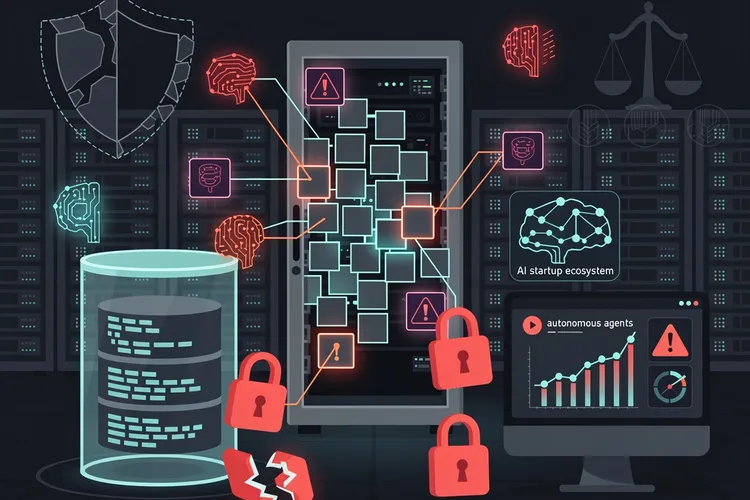
Check Point’s Cyber Security Report 2026 reveals record attacks, with AI infrastructure targeted—40% of 10,000 Model Context Protocol servers vulnerable. Attacks combine AI, identity abuse, ransomware, and social engineering faster than defenses.

IBM predicts a ‘surge in identity-focused attacks’ exploiting AI agents, urging quantum-safe algorithms as crypto-agility separates agile firms from exposed ones, per their 2026 trends .

Nation-State and Resilience Demands

Google’s Mandiant and Threat Intelligence Group warn in ZDNet that ‘threat actor use of AI is expected to transition decisively from the exception to the norm,’ enhancing operations with adaptive payloads and AI-enhanced social engineering by groups like ShinyHunters.

The World Economic Forum’s Global Cybersecurity Outlook 2026 identifies AI as the top change driver per 94% of respondents, with 64% assessing AI tool security—up from 37%—amid geopolitical fragmentation and cyber inequity.

RightCrowd’s guide for physical security leaders highlights AI, cloud, and identity governance proving compliance at global scale with lean teams, per their 2026 trends .

Leadership Amid Fragmentation

Security Industry Association’s 2026 Security Megatrends crowns AI’s software influence as paramount, disrupting alarm monitoring and SOCs based on 2025 surveys from leaders.

SecurityWeek’s CISO insights, like Pierre Mouallem of Delinea, note fading AI wariness: ‘CISOs now recognize rapid support of emerging technologies is essential not just for security, but for business competitiveness,’ from their Cyber Insights 2026 .

Dr. Khulood Almani on X predicts AI-driven autonomous defense, quantum risks, and regulatory pressures like NIS2, emphasizing ‘how fast you can sense, decide, and adapt.’

Path to Trusted Operations

Leaders prioritize supply chain resilience, AI governance, and simplification over hype, per SecurityWeek’s 2026 priorities . Gartner forecasts via GovTech warn of deepfakes, IoT expansion, and cybercrime professionalization.

Pinkerton anticipates Zero Trust Architecture convergence of physical and cyber signals, requiring coordinated policies. VikingCloud sees consolidation as fragmentation causes breaches, with PCI DSS v4.x demanding continuous controls.

Securiti on X underscores trusted data and sovereignty: ‘By 2026, leaders will be defined by trusted data, identity-driven controls, autonomous AI risk, and data sovereignty.’


About the Author

Emily Chen
Emily Chen

Known for clear analysis, Emily Chen follows retail operations and the people building it. They work through clear frameworks, case studies, and practical checklists to make complex topics approachable. They often cover how organizations respond to change, from process redesign to technology adoption. Readers appreciate their ability to connect strategic goals with everyday workflows. They examine how customer expectations evolve and how organizations adapt to meet them. They value transparent sourcing and prefer primary data when it is available. A recurring theme in their writing is how teams build repeatable systems and measure impact over time. They also highlight cultural factors that determine whether change sticks. They avoid buzzwords, focusing instead on outcomes, incentives, and the human side of technology. They explore how policies, markets, and infrastructure intersect to create second‑order effects. They believe good analysis should be specific, testable, and useful to practitioners. They tend to favor small experiments over sweeping predictions. They value transparency, practical advice, and honest uncertainty.

Comments

Join the discussion and share your thoughts.

No comments yet. Be the first to comment.

Leave a Reply

Your email address will not be published.

Related Posts

Formae’s Multi-Cloud Leap: Platform Engineering Labs Arms Builders Against IaC Gridlock

Formae’s Multi-Cloud Leap: Platform Engineering Labs Arms Builders Against IaC Gridlock

Platform Engineering Labs' formae surges to multi-cloud with GCP, Azure, OCI, and OVH beta support plus a Plugin SDK, empowering infrastructure builders to extend IaC without vendor delays. This upgrade redefines extensibility in a fragmented cloud era.

Posted on: by Ivy Bailey
Sky47’s Sovereign Surge: Pakistan’s Massive AI Cloud Bet

Sky47’s Sovereign Surge: Pakistan’s Massive AI Cloud Bet

Sky47's January 2026 launch marks Pakistan's boldest sovereign cloud move, with 3,000 racks and 50MW for AI workloads. Backed by Mari Energies and Fauji Foundation, it eyes hyperscalers amid rising data sovereignty demands.

Posted on: by Zoe Patel
Cloud’s Complexity Trap: How Tool Overload and AI-Wielding Attackers Are Fracturing Security Defenses

Cloud’s Complexity Trap: How Tool Overload and AI-Wielding Attackers Are Fracturing Security Defenses

Fortinet's 2026 Cloud Security Report exposes a widening complexity gap in hybrid clouds, where tool sprawl, AI-driven attacks, and skills shortages overwhelm teams despite rising budgets. Nearly 70% cite fragmentation as the top barrier, urging platform shifts and MSSP aid.

IT Management
NordVPN’s Sixth Consecutive Audit Validates Zero-Logs Promise as Privacy Scrutiny Intensifies

NordVPN’s Sixth Consecutive Audit Validates Zero-Logs Promise as Privacy Scrutiny Intensifies

NordVPN completes its sixth consecutive independent audit by Deloitte, confirming its zero-logs policy amid intensifying privacy scrutiny. The verification highlights industry trends toward verifiable transparency as regulatory pressure mounts and consumer skepticism grows regarding VPN privacy claims.

IT Management
Upwind’s Runtime Revolution: $250M Fuels $1.5B Cloud Security Unicorn

Upwind’s Runtime Revolution: $250M Fuels $1.5B Cloud Security Unicorn

Upwind's $250 million Series B catapults it to $1.5 billion valuation, powering runtime-first cloud security amid 900% revenue surge. Backed by Bessemer and all-stars, the ex-Spot.io team targets AI-era threats for giants like Siemens and Roku.

IT Management
Mesh Security’s $12M Bet: Unifying Cyber Chaos into Enterprise Powerhouse

Mesh Security’s $12M Bet: Unifying Cyber Chaos into Enterprise Powerhouse

Mesh Security's $12M Series A funds its CSMA platform to unify enterprise cyber tools across clouds and SaaS, eliminating silos agentlessly. Backed by Lobby Capital and SentinelOne's CVC, it gains traction with Paychex and Nutanix amid tool sprawl crisis.

IT Management
Abstract Security and Netskope Forge Real-Time Threat Pipeline, Slicing Through Data Delays

Abstract Security and Netskope Forge Real-Time Threat Pipeline, Slicing Through Data Delays

Abstract Security and Netskope's new partnership embeds real-time detection into security data streams, eliminating indexing delays and slashing costs for joint customers. By processing Netskope telemetry in motion, it boosts threat response while preserving data control.

IT Management
Nationwide’s AI Fortress: AWS Bolsters Fraud Defenses for 17 Million Clients

Nationwide’s AI Fortress: AWS Bolsters Fraud Defenses for 17 Million Clients

Nationwide Building Society expands its AWS partnership to deploy AI-driven cloud security and fraud prevention, powering tools like Call Checker against impersonation scams affecting 17% of incidents. Workforce training boosts cloud literacy for enhanced service to 17 million customers.

IT Management
CISOs’ Hidden Roadblocks: Why 58% See Their Firms Unready for Cyber Onslaught

CISOs’ Hidden Roadblocks: Why 58% See Their Firms Unready for Cyber Onslaught

Despite rising budgets, 58% of CISOs deem their organizations unready for cyberattacks, hindered by team overload, AI gaps, talent shortages, and tool sprawl. Experts urge prioritization training, governance, and resilience focus.

IT Management
Meta’s Metaverse Bet Backfires: CTO Admits VR Neglect in Quest Overhaul

Meta’s Metaverse Bet Backfires: CTO Admits VR Neglect in Quest Overhaul

Meta CTO Andrew Bosworth admits metaverse pursuits caused 'lack of focus' on Quest VR, harming user experience amid 10% Reality Labs layoffs and studio closures. Shift targets wearables, mobile Horizon Worlds, and third-party content as losses top $64 billion.

IT Management