





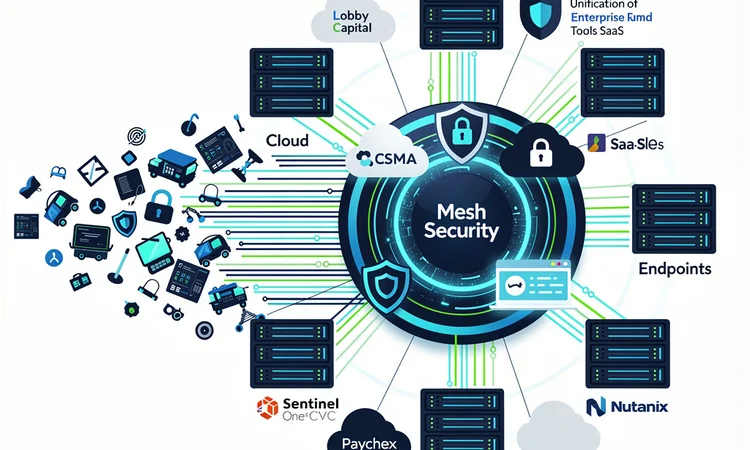
Mesh Security, a Palo Alto-based cybersecurity startup with roots in Israel, has secured $12 million in Series A funding to propel its pioneering Cybersecurity Mesh Architecture (CSMA) platform into the heart of enterprise defenses. Led by Lobby Capital, the round drew participation from S Ventures—the corporate venture arm of SentinelOne—and Bright Pixel Capital, bringing the company’s total funding to $18 million since its founding in early 2022. The investment arrives amid escalating demands for integrated security amid exploding tool counts, with the average enterprise now juggling 83 security tools across 29 vendors, as noted on Mesh Security’s site .
The platform positions itself as the long-awaited execution layer atop fragmented stacks, connecting identity, endpoints, cloud, SaaS, networks, data protection, and CI/CD pipelines into a cohesive operating model. Agentless and API-driven, it deploys in minutes without ripping out existing investments, unifying data into an identity-first graph for real-time visibility, automated posture hardening, threat detection, investigation, and response. “For years, enterprise security has accumulated tools and data, but it never built an execution layer that connects them into a single operating model,” said Netanel (Neo) Azoulay, CEO and co-founder of Mesh Security, in a statement shared across PR Newswire and Tech Startups .
Founders’ Battlefield-Honed Vision
Azoulay and co-founder Omri Hering, CTO, bring deep credentials from Israel’s elite Unit 324 of the Air Force, where they spent 15 years designing resilient distributed cloud networks and researching cybersecurity from both offensive and defensive angles. Azoulay’s career spans roles as a network solutions architect at Elbit Systems, VP of sales at Septier Communications and Monolith Digital Advantages, and a prior stealth cybersecurity venture. Hering complements with technical expertise in cloud-native defenses. Their military background informs Mesh’s focus on operationalizing Gartner’s CSMA vision—a composable ecosystem centralizing data and controls for distributed enterprises, as Calcalistech detailed in its funding report.
Previously emerging from stealth with a $4.5 million seed in 2024—backed by Plug and Play, Recursive Ventures, and Booster Ventures—Mesh targeted Zero Trust Posture Management (ZTPM). The Series A accelerates autonomous AI agents that reason over cross-domain attack paths, enabling system-level remediation and shifting from human-driven ops to proactive exposure elimination. Funds will also scale sales and support for surging enterprise demand, per the SiliconANGLE coverage.
Real-World Traction Amid Tool Sprawl
Mesh’s resonance is evident in production deployments alongside partners like SentinelOne, powering adaptive defenses across silos. Notable customers include Paychex, Nutanix, Hippo Holdings, Kaltura, Guesty, and Lightico. “Mesh provides a clear way to understand where a security program stands,” said Bradley Schaufenbuel, VP and CISO at Paychex. “It helps identify the critical gaps that actually matter and drives the process of closing them. What stands out is that it doesn’t require replacing existing tools, it’s designed to make the security stack work as one zero trust system.” This testimonial, echoed in PR Newswire and Tech Startups , underscores the platform’s no-disruption appeal.
The company quantifies Zero Trust across all six pillars—identity, devices, networks, applications, data, and visibility—via continuous gap analysis and control validation. Its Mesh AI Insights deliver instant, context-rich answers, while agents autonomously fix posture risks and detection gaps, prioritizing crown jewel assets. On its site , Mesh highlights how CSMA slashes financial breach impacts by 90% on average, per Gartner, by breaking silos and enabling unified intelligence.
Investor Confidence in CSMA Execution
“Mesh’s platform is uniquely positioned to help enterprises achieve true cybersecurity mesh architecture in an era of increasing complexity,” said Buddy Arnheim, founding partner at Lobby Capital, in quotes to SiliconANGLE and PR Newswire . S Ventures’ involvement signals validation from endpoint leader SentinelOne, while Bright Pixel’s stake aligns with its cybersecurity portfolio. Lobby Capital, focused on Israeli tech scaling globally, sees Mesh as a pioneer in unified ops.
This funding reflects boardroom mandates for platformization amid rising exposures. Enterprises face pressure to cut risk, prove ROI, and accelerate ops, yet legacy architectures falter at scale. Mesh’s agentless overlay transforms mosaics of dashboards into a single trusted view, automating what manual correlation cannot, as articulated in Tech Startups .
Navigating a Fragmented Defense Market
In a field crowded with point solutions, Mesh differentiates by embracing best-of-breed stacks rather than demanding lock-in. It integrates SIEM, XDR, ITDR, vulnerability managers, and more into a data graph, surfacing viable attack paths and prioritizing fixes. Blogs on its site critique the ‘single pane of glass’ myth, arguing CSMA delivers it after decades of promises, amid exploding SIEM costs (15-30% annual hikes) and low breach detection (42% via internal tools).
Competitors like Palo Alto Networks, Check Point, and IBM push CSMA elements, but Mesh claims first-mover status in full execution. Its focus on non-human identities, multi-cloud/SaaS sprawl, and AI-driven autonomy targets gaps where tools excel individually but fail systemically. With 25 employees split between Palo Alto HQ and Israel R&D, Mesh eyes rapid expansion, fueled by this capital infusion amid 2026’s high-tech funding surge tracked by Calcalistech .
Charting Enterprise-Scale Momentum
The timing is prescient: As attacks proliferate across hybrid environments, CSMA shifts security from perimeter castles to fluid, identity-anchored perimeters. Mesh’s platform assumes breach, eliminates exposures proactively, and measures maturity rigorously—enabling CISOs to report credibly to boards. Investor and customer endorsements, coupled with agentic AI roadmaps, position Mesh to capture share in a market demanding interoperability over silos.
Early X discussions, including posts from @Calcalistech and @SiliconANGLE , amplify the buzz, with Bright Pixel touting CSMA adoption acceleration. As Mesh scales, it could redefine how enterprises operationalize sprawling investments, proving that true unity turns cyber chaos into scalable strength.






Leave a Reply
Your email address will not be published.