AI Product Managers: Mastering the Tech-Business Bridge in 2026

Grace Wright
Grace Wright

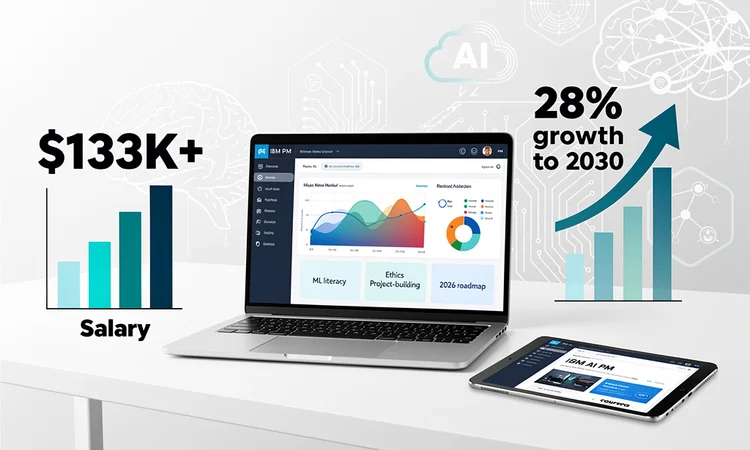
AI product managers bridge tech and business, commanding $133K+ salaries amid 28% growth to 2030. This deep dive covers skills like ML literacy, certifications such as IBM's Coursera program, project-building, ethics, and 2026 roadmaps for insiders eyeing high-demand roles.

AI Product Managers: Mastering the Tech-Business Bridge in 2026

In the high-stakes arena of artificial intelligence, where companies race to embed machine learning into everything from fraud detection to customer service chatbots, the AI product manager has emerged as a pivotal figure. This role demands not just strategic acumen but a nuanced grasp of algorithms, data pipelines, and ethical pitfalls, positioning professionals to command salaries averaging $133,600 in the U.S., with senior roles climbing to $200,000 or more, according to Research.com .

Unlike traditional product managers, AI counterparts must navigate model drift, bias audits, and the integration of tools like TensorFlow and Hugging Face. Demand surges across fintech, healthcare, and SaaS, with projections showing 28% growth through 2030. As Kanika Tolver noted in a recent post, breaking into this field requires a deliberate path amid tech’s fastest-growing high-paying roles.

The journey starts with foundational education. Professionals often pursue certifications blending product strategy and AI fundamentals, such as the IBM AI Product Manager Professional Certificate on Coursera, which equips learners with prompt engineering and AI skills in three months, no prior experience needed.

Core Technical Literacy Demanded by Employers

Technical literacy tops the skillset. AI product managers must comprehend supervised versus unsupervised learning, neural networks, and metrics like F1-score or RMSE. As outlined in Simplilearn , this involves interpreting model outputs and limitations to guide development. Proficiency in Python libraries—Pandas, NumPy—and SQL for data querying is non-negotiable, enabling analysis of trends via Tableau or Power BI.

Hands-on tool mastery follows. Familiarity with PyTorch, scikit-learn, and MLflow for experiment tracking allows managers to oversee model training and validation without coding everything themselves. JustAnotherPM emphasized on X: “Master ML models, GenAI and LLMs/SLMs… Data quality and labeling is 80% of the real AI work.”

Product thinking integrates AI into business outcomes. Managers design experiments linking model performance to KPIs, such as retention boosts from recommendation engines. Feature prioritization using frameworks like RICE balances quick wins, like fraud detection, against long-term initiatives.

Building Experience Through Projects and Portfolios

Gaining traction demands practical projects. Start with predictive churn models using scikit-learn, documenting objectives, datasets, results, and impacts—like a 10% retention increase—for GitHub portfolios. Eleken.co advises showcasing visuals such as dashboards to demonstrate business value.

Networking amplifies visibility. Engage LinkedIn groups, AI webinars, and mentorship from practicing managers. Transitioners from non-technical roles should collaborate with data teams, embedding AI features into existing products. Interview prep focuses on scenarios: handling biased predictions or prioritizing amid resource constraints.

Certifications accelerate entry. Duke’s AI Product Management Specialization on Coursera covers tech integration and ethics, while Product School’s program builds PRDs and roadmaps with real-world frameworks. Maven’s AI Product Management Certification, rated #1, prepares for 2026’s AI-driven decisions.

Daily Realities: From Strategy to Deployment

AI product managers define goals, translating needs into solutions like NLP for support via Hugging Face. They prioritize roadmaps, collaborate on pipelines, and monitor post-deployment for drift. Ethics loom large: bias audits, privacy compliance, and fairness checks are routine, as MyGreatLearning details.

Insights fuel decisions—churn predictions trigger campaigns, dashboards inform executives. Cross-functional alignment with engineers and data scientists ensures scalable, accurate outputs. In enterprise settings, RAG systems and agentic workflows dominate, per X discussions on observability and governance.

Career progression spans junior roles to leads shaping strategy. Industries hiring aggressively include e-commerce, healthcare, and enterprise software. U.S. medians hit $198,000 total compensation in some reports, per Glassdoor data cited across sources.

Navigating Ethics, Governance, and Future Shifts

Ethics awareness distinguishes top performers. Managers conduct audits, apply privacy practices, and navigate regulations. Prompt engineering, context design, and evals combat hallucinations, as stressed in X threads: “LLM evaluation and benchmarking—you can’t improve what you can’t measure.”

Composable AI via APIs and low-code tools like n8n speeds iteration. Governance frameworks ensure safety and compliance. For 2026, small language models and fine-tuning gain traction over massive LLMs, optimizing costs and performance.

Job hunting targets LinkedIn, Glassdoor, AngelList. Highlight projects, seek referrals. As demand outpaces supply, those blending strategy, tech fluency, and ethics will thrive, turning AI from buzzword to revenue driver.

Salary Benchmarks and Market Momentum

Compensation reflects scarcity. Entry-level starts at $100,000-$120,000, mid-level $120,000-$150,000, seniors $150,000-$200,000+, varying by location and firm, per Eleken.co and Glassdoor. India’s averages hover at ₹25 lakhs annually.

Global openings exceed 14,000, with U.S. dominance. X buzz from ProductDive and TechSkill underscores bootcamps filling the gap, starting cohorts in early 2026. Continuous upskilling—via Udacity Nanodegrees or Microsoft certificates—sustains edge in this dynamic field.

About the Author

Grace Wright
Grace Wright

As a writer, Grace Wright covers platform engineering with an eye for detail. They work through clear frameworks, case studies, and practical checklists to make complex topics approachable. Readers appreciate their ability to connect strategic goals with everyday workflows. They also highlight cultural factors that determine whether change sticks. They examine how customer expectations evolve and how organizations adapt to meet them. Their coverage includes guidance for teams under resource or time constraints. They write about both the promise and the cost of transformation, including risks that are easy to overlook. A recurring theme in their writing is how teams build repeatable systems and measure impact over time. They value transparent sourcing and prefer primary data when it is available. They are known for dissecting tools and strategies that improve execution without adding complexity. They look for overlooked details that differentiate sustainable success from short‑term wins. They watch the policy landscape closely when it affects product strategy. They prefer evidence over hype and explain trade‑offs plainly.

Comments

Join the discussion and share your thoughts.

No comments yet. Be the first to comment.

Leave a Reply

Your email address will not be published.

Related Posts

Atlantic’s $1.2 Billion Staffing Power Play: F1 Tech Talent Fuels Transatlantic Surge

Atlantic’s $1.2 Billion Staffing Power Play: F1 Tech Talent Fuels Transatlantic Surge

Atlantic International Corp. acquires Circle8 Group in an all-stock deal, creating a $1.2 billion global staffing platform blending U.S. industrial and European IT talent. Circle8's Aston Martin F1 partnership highlights its elite capabilities amid cross-selling potential.

Posted on: by Liam Price
Bots at Work: Service Robotics’ $500 Billion Surge Reshapes Labor Markets

Bots at Work: Service Robotics’ $500 Billion Surge Reshapes Labor Markets

Service robotics rockets toward $498 billion by 2033 at 37% CAGR, automating logistics, healthcare, and hospitality amid AI advances and labor crunches. Deals like Serve's Diligent buy propel indoor expansions.

Posted on: by Layla Reed
Aspire-Deel Tie-Up Reshapes Global Hiring for Fintech Startups

Aspire-Deel Tie-Up Reshapes Global Hiring for Fintech Startups

Aspire integrates Deel's EOR services for seamless global hiring and finance management, targeting startups scaling internationally. The partnership addresses compliance hurdles, offering unified insights into workforce costs and cash flow.

Business
Deel’s Record-Breaking Hiring Spectacle: AI-Powered Push Reshapes Global Talent Wars

Deel’s Record-Breaking Hiring Spectacle: AI-Powered Push Reshapes Global Talent Wars

Deel shattered records with 6,848 attendees at its largest online hiring event, blending AI tools and global reach to fill 300+ sales roles. Amid growth to $17.3 billion valuation, the feat highlights innovations in HR and payroll but sparks debate on stunt versus substance.

Business
Deel’s $17 Billion Sprint: From Y Combinator to Global Payroll Powerhouse

Deel’s $17 Billion Sprint: From Y Combinator to Global Payroll Powerhouse

Deel rocketed to a $17.3 billion valuation in seven years by pioneering owned global payroll infrastructure, processing $22 billion annually for 37,000 firms. Amid IPO prep and DOJ scrutiny, COO Dan Westgarth reveals elite ops driving $1 billion revenue.

Business
HR’s AI Superagent Revolution: Reinventing the Workforce Engine

HR’s AI Superagent Revolution: Reinventing the Workforce Engine

Enterprise AI Superagents ignite HR's biggest transformation in decades, automating 30-40% of jobs while birthing full-stack roles and skills-first strategies. Josh Bersin leads the charge amid bias risks and tech trends reshaping hiring, experience, and leadership.

Business
AI’s HR Reckoning: 10 Pivotal Shifts Reshaping Workforce Strategies in 2026

AI’s HR Reckoning: 10 Pivotal Shifts Reshaping Workforce Strategies in 2026

As AI propels organizations into hybrid human-machine teams, HR must master fluency screening, skills-based shifts and agentic governance to thrive amid 2026's disruptions, blending tech efficiency with human resilience.

Business
The Upselling Paradox: How Retailers Walk the Tightrope Between Revenue Growth and Consumer Trust

The Upselling Paradox: How Retailers Walk the Tightrope Between Revenue Growth and Consumer Trust

New research reveals upselling's hidden risks as retailers balance revenue growth with customer trust. While upselling can boost transaction values by 10-30%, approximately 23% of consumers experience post-purchase regret, potentially damaging long-term profitability and brand reputation in an increasingly skeptical marketplace.

Business
Chrome Extensions’ Silent Siege on Enterprise HR Crown Jewels

Chrome Extensions’ Silent Siege on Enterprise HR Crown Jewels

Five malicious Chrome extensions hijacked sessions on Workday, NetSuite, and SAP SuccessFactors, stealing cookies, blocking admin pages, and enabling takeovers. Socket's discovery prompted Google takedowns after 2,300 installs, exposing enterprise browser risks.

Business
AI Proficiency Divide: HR’s Mounting Crisis

AI Proficiency Divide: HR’s Mounting Crisis

Corporate AI adoption surges, but superficial employee use creates a proficiency chasm now demanding HR intervention through targeted training, outcome metrics, and equity for overlooked workers.

Business