
GrackerAI’s GEO Gambit: Rewiring Cybersecurity Sales in the AI Search Era

Vivian Stewart
Vivian Stewart

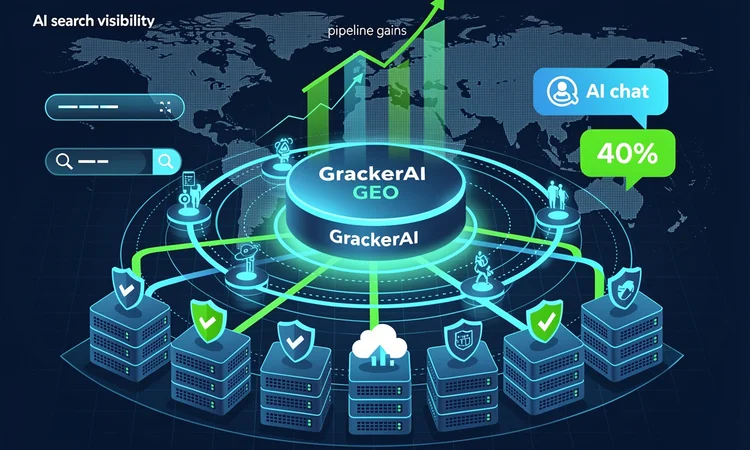
GrackerAI's new GEO platform equips cybersecurity SaaS firms to dominate AI search visibility, addressing a 40% buyer shift to chatbots and promising sharp pipeline gains amid evolving search dynamics.

GrackerAI’s GEO Gambit: Rewiring Cybersecurity Sales in the AI Search Era

In the high-stakes world of cybersecurity software, where chief information security officers sift through endless vendor pitches, a San Francisco startup is betting that artificial intelligence will dictate who wins the next deal. GrackerAI launched what it calls the industry’s first Generative Engine Optimization (GEO) platform on January 20, 2026, targeting go-to-market teams at cybersecurity SaaS firms desperate to appear in AI responses from tools like ChatGPT, Claude, Gemini, Perplexity and Google AI Overviews.

The platform arrives amid a pivotal shift: 40% of B2B buyers, including CISOs and security architects, now rely on AI assistants for initial software research, bypassing traditional Google searches. ‘Buyers now ask AI for IAM solutions, SIEM alternatives, & zero-trust platforms rather than relying on Google. If your brand isn’t in that AI response, you’re not in the buying conversation,’ said Deepak Gupta, CEO and co-founder of GrackerAI, in the launch announcement distributed via Southwest Times .

GrackerAI, backed by the NVIDIA Startups Program, Cloudflare Launchpad and Microsoft for Startups, with partnerships including OpenAI and Anthropic, promises to bridge the chasm between Google dominance and AI invisibility. Early adopters report 40% jumps in AI visibility scores within 90 days, 40-80% growth in AI-referred signups and 3-5x higher conversion rates from such traffic, per the company’s data.

Decoding the AI Visibility Crisis

Cybersecurity vendors have poured millions into SEO, only to find their top Google rankings meaningless when prospects query AI chatbots. ‘We’ve observed cybersecurity companies ranking #1 on Google for their core solutions remain completely invisible when prospects ask ChatGPT or Claude for vendor recommendations. That disconnect is costing companies millions in lost pipeline,’ Gupta added.

GrackerAI’s monitoring tools track real-time brand mentions across AI platforms, benchmark against competitors and pinpoint high-value security query topics like threat detection or compliance automation. The platform then automates content creation tailored for AI citation—think threat intelligence reports, CVE databases and breach analyses—pulling from over 200 sources including the National Vulnerability Database, MITRE CVE and CISA’s Known Exploited Vulnerabilities catalog.

Govind Kumar, CTO and co-founder, emphasized the technical chasm: ‘The gap between SEO rankings and AI citations is massive in the cybersecurity space. Security teams searching for vulnerability management, compliance automation, or threat intelligence get AI recommendations that often exclude companies who dominate traditional search rankings.’

Engineering Content for AI Trust Signals

Unlike generic SEO tools, GrackerAI deploys cybersecurity-specific AI models trained on threat intelligence jargon, ensuring outputs match the precision CISOs demand. Programmatic SEO portals scale CVE breakdowns or compliance frameworks, structuring data to mimic patterns AI engines prioritize for synthesis into responses.

A free Seed plan lets firms test up to 50 optimized pages, with paid tiers unlocking unlimited portals and real-time integrations. The platform is live at portal.gracker.ai , as noted in coverage by Columbia Daily Tribune and National Law Review .

Founded by Gupta, previously of LoginRadius, and Kumar, an AI/ML specialist, GrackerAI positions itself as the pioneer in a nascent GEO category. Its blog and tools, detailed on gracker.ai , extend to broader B2B SaaS, but cybersecurity remains the focus given the sector’s technical demands.

Broader GEO Momentum Meets Sector Headwinds

The launch coincides with surging GEO interest. Princeton researchers coined the term in 2023, showing optimizations like statistics and quotes boost AI visibility 30-40%, a finding echoed in GrackerAI’s approach, as covered in GrackerAI’s insights hub . Gartner forecasts a 25% drop in traditional search volume by 2026, per analyses from Tutorials Dojo .

Cybersecurity GTM leaders face compounded pressures. World Economic Forum’s Global Cybersecurity Outlook 2026 flags AI as the top change driver for 94% of respondents, with fraud surging and geopolitics amplifying risks, via World Economic Forum . GrackerAI counters by positioning brands in AI answers for categories like CNAPP, SIEM and identity management.

On X, CIO Influence amplified the launch, while GrackerAI’s account (@grackerAI) promotes tools like its fact-checker for cybersecurity claims. No major user testimonials emerged yet, but the platform’s integrations signal enterprise readiness.

Measuring ROI in an Unproven Arena

GrackerAI dashboards track AI-referred traffic, lead quality and conversions, claiming 20-35% lifts in qualified security leads. Yet GEO remains experimental; AI models evolve rapidly, potentially disrupting citations overnight. Princeton’s methods—authoritative phrasing, sourced data—underpin GrackerAI, but long-term efficacy hinges on continuous adaptation.

Competitors like Opollo and Intero Digital eye GEO for tech firms, per Opollo , but none match GrackerAI’s cybersecurity depth. Broader trends favor topic clusters over keywords and E-E-A-T signals, aligning with the platform’s strengths, as outlined in SEO.com .

For cybersecurity SaaS, where deals hinge on early awareness, GrackerAI offers a hedge against AI-driven discovery black holes. As Gupta put it, exclusion from AI responses means missing the conversation entirely—a risk few vendors can afford in 2026’s accelerating threat environment.

About the Author

Vivian Stewart
Vivian Stewart

As a writer, Vivian Stewart covers retail operations with an eye for detail. They work through comparative reviews and hands‑on testing to make complex topics approachable. They believe good analysis should be specific, testable, and useful to practitioners. They frequently translate research into action for marketing teams, prioritizing clarity over buzzwords. Their coverage includes guidance for teams under resource or time constraints. They explore how policies, markets, and infrastructure intersect to create second‑order effects. They write about both the promise and the cost of transformation, including risks that are easy to overlook. They frequently compare approaches across industries to surface patterns that travel well. Readers appreciate their ability to connect strategic goals with everyday workflows. Their reporting blends qualitative insight with data, highlighting what actually changes decision‑making. They maintain a balanced tone, separating speculation from evidence. They are known for dissecting tools and strategies that improve execution without adding complexity. They emphasize decision‑making under uncertainty and imperfect data. Their work aims to be useful first, timely second.

Comments

Join the discussion and share your thoughts.

No comments yet. Be the first to comment.

Leave a Reply

Your email address will not be published.

Related Posts

Atlantic’s $1.2 Billion Staffing Power Play: F1 Tech Talent Fuels Transatlantic Surge

Atlantic’s $1.2 Billion Staffing Power Play: F1 Tech Talent Fuels Transatlantic Surge

Atlantic International Corp. acquires Circle8 Group in an all-stock deal, creating a $1.2 billion global staffing platform blending U.S. industrial and European IT talent. Circle8's Aston Martin F1 partnership highlights its elite capabilities amid cross-selling potential.

Posted on: by Liam Price
Bots at Work: Service Robotics’ $500 Billion Surge Reshapes Labor Markets

Bots at Work: Service Robotics’ $500 Billion Surge Reshapes Labor Markets

Service robotics rockets toward $498 billion by 2033 at 37% CAGR, automating logistics, healthcare, and hospitality amid AI advances and labor crunches. Deals like Serve's Diligent buy propel indoor expansions.

Posted on: by Layla Reed
Aspire-Deel Tie-Up Reshapes Global Hiring for Fintech Startups

Aspire-Deel Tie-Up Reshapes Global Hiring for Fintech Startups

Aspire integrates Deel's EOR services for seamless global hiring and finance management, targeting startups scaling internationally. The partnership addresses compliance hurdles, offering unified insights into workforce costs and cash flow.

Business
Deel’s Record-Breaking Hiring Spectacle: AI-Powered Push Reshapes Global Talent Wars

Deel’s Record-Breaking Hiring Spectacle: AI-Powered Push Reshapes Global Talent Wars

Deel shattered records with 6,848 attendees at its largest online hiring event, blending AI tools and global reach to fill 300+ sales roles. Amid growth to $17.3 billion valuation, the feat highlights innovations in HR and payroll but sparks debate on stunt versus substance.

Business
Deel’s $17 Billion Sprint: From Y Combinator to Global Payroll Powerhouse

Deel’s $17 Billion Sprint: From Y Combinator to Global Payroll Powerhouse

Deel rocketed to a $17.3 billion valuation in seven years by pioneering owned global payroll infrastructure, processing $22 billion annually for 37,000 firms. Amid IPO prep and DOJ scrutiny, COO Dan Westgarth reveals elite ops driving $1 billion revenue.

Business
HR’s AI Superagent Revolution: Reinventing the Workforce Engine

HR’s AI Superagent Revolution: Reinventing the Workforce Engine

Enterprise AI Superagents ignite HR's biggest transformation in decades, automating 30-40% of jobs while birthing full-stack roles and skills-first strategies. Josh Bersin leads the charge amid bias risks and tech trends reshaping hiring, experience, and leadership.

Business
AI’s HR Reckoning: 10 Pivotal Shifts Reshaping Workforce Strategies in 2026

AI’s HR Reckoning: 10 Pivotal Shifts Reshaping Workforce Strategies in 2026

As AI propels organizations into hybrid human-machine teams, HR must master fluency screening, skills-based shifts and agentic governance to thrive amid 2026's disruptions, blending tech efficiency with human resilience.

Business
The Upselling Paradox: How Retailers Walk the Tightrope Between Revenue Growth and Consumer Trust

The Upselling Paradox: How Retailers Walk the Tightrope Between Revenue Growth and Consumer Trust

New research reveals upselling's hidden risks as retailers balance revenue growth with customer trust. While upselling can boost transaction values by 10-30%, approximately 23% of consumers experience post-purchase regret, potentially damaging long-term profitability and brand reputation in an increasingly skeptical marketplace.

Business
Chrome Extensions’ Silent Siege on Enterprise HR Crown Jewels

Chrome Extensions’ Silent Siege on Enterprise HR Crown Jewels

Five malicious Chrome extensions hijacked sessions on Workday, NetSuite, and SAP SuccessFactors, stealing cookies, blocking admin pages, and enabling takeovers. Socket's discovery prompted Google takedowns after 2,300 installs, exposing enterprise browser risks.

Business
AI Proficiency Divide: HR’s Mounting Crisis

AI Proficiency Divide: HR’s Mounting Crisis

Corporate AI adoption surges, but superficial employee use creates a proficiency chasm now demanding HR intervention through targeted training, outcome metrics, and equity for overlooked workers.

Business