








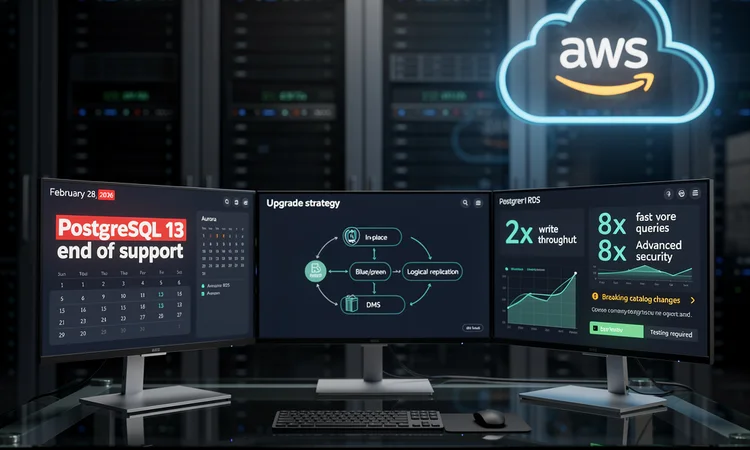
Standard support for Amazon Aurora PostgreSQL-Compatible Edition and Amazon RDS for PostgreSQL version 13 ends on February 28, 2026, pressing database administrators to act swiftly. PostgreSQL 13, deprecated by the community in November 2025, will cease receiving bug fixes and security patches, exposing systems to vulnerabilities. AWS urges upgrades to newer versions like 16 or 17 for performance gains, enhanced security, and advanced features, as detailed in a January 27, 2026, post by Abhimanyu Tomar, Sachin Murkar, and Niraj Jani on the AWS Database Blog .
Newer releases deliver tangible benefits. PostgreSQL 17 offers up to 2x better write throughput through enhanced WAL processing and uses 20x less memory in vacuum operations. Version 16 introduces pg_stat_io for detailed I/O statistics, while version 14 adds vacuum emergency mode to avert transaction ID wraparound. Aurora-specific optimizations in version 14.9 and later, such as tiered caching extending up to 5x instance memory on I/O-Optimized clusters, yield up to 8x faster query latency and 30% cost savings for large datasets, according to AWS documentation.
Security improvements are equally compelling. Version 14 introduces roles like pg_read_all_data and pg_write_all_data for streamlined access control, and version 15 revokes PUBLIC creation permission on the public schema. Logical replication sees major upgrades: version 17 enables automatic slot synchronization during failover, and version 16 supports parallel apply with multiple background workers.
Navigating Breaking Changes
Major version shifts bring catalog alterations that demand scrutiny. In PostgreSQL 17, pg_stat_bgwriter loses buffers_backend and buffers_backend_fsync columns, replaced by the new pg_stat_checkpointer view. pg_stat_progress_vacuum renames max_dead_tuples to max_dead_tuple_bytes and adds columns like indexes_total. Configuration parameters evolve too: password_encryption defaults shift from md5 to scram-sha-256 in version 14, and wal_compression gains zstd and lz4 support in version 15. “Review all changes carefully—some may break applications relying on deprecated views or parameters,” warn the AWS authors.
Views like pg_stat_activity gain a query_id column requiring compute_query_id in version 14, and pg_database adds dathasloginevt while renaming daticulocale to datlocale. These shifts, documented across AWS release notes, necessitate pre-upgrade testing in staging environments to catch compatibility issues early.
Extensions must be verified; most do not auto-upgrade. Logical replication slots using pglogical require dropping before major upgrades, as noted in Amazon RDS User Guide on performing major version upgrades.
In-Place Upgrades for Simplicity
The most straightforward path is in-place major version upgrade via AWS Console or CLI, leveraging pg_upgrade under the hood. Downtime scales with database size, so AWS recommends snapshot-based testing first. “Direct upgrade of the DB instance,” the AWS Database Blog describes, suits workloads tolerant of planned outages. For Aurora clusters post-version 13.7.3, zero-downtime patching (ZDP) minimizes disruptions during minor upgrades, per Aurora User Guide.
CLI checks valid targets: aws rds describe-db-engine-versions –engine aurora-postgresql –engine-version 13.x –query ‘DBEngineVersions[].ValidUpgradeTarget[?IsMajorVersionUpgrade == `true`].{EngineVersion:EngineVersion}’. From 13, paths lead to 14, 15, 16, or 17, though direct jumps to 17 may require intermediate steps for certain extensions like rdkit.
Preparation includes validating instance classes, parameter groups, and dropping replication slots. Post-upgrade, re-enable extensions with ALTER EXTENSION UPDATE.
Blue/Green Deployments Minimize Risk
For near-zero downtime, Amazon RDS Blue/Green deployments shine, using PostgreSQL logical replication to sync production (blue) with a staging (green) environment. Upgrade green via one-click, test applications, then switch traffic in under a minute. Supported from Aurora PostgreSQL 13.12+, as in earlier AWS blogs on version 12 strategies. “DDL changes aren’t replicated and can break the process,” cautions the January 2026 post; avoid schema alterations during sync.
Reddit users on r/aws report parameter tweaks like enabling rds.logical_replication=1 before blue/green creation from version 13.18 to 17.5. This managed approach handles cutovers automatically, ideal for production continuity.
Global databases add complexity; upgrade the global cluster first with aws rds modify-global-cluster –allow-major-version-upgrade, per AWS re:Post guidance.
Replication and DMS for Complex Migrations
Logical replication via pglogical offers flexibility: snapshot the publisher, seed the subscriber, then replicate changes continuously. Pros include minimal downtime; cons exclude DDL, sequences, and large objects. Initial sync times challenge large databases, but parallel apply in version 16 accelerates it.
AWS DMS provides homogeneous migration with CDC for both Aurora and RDS PostgreSQL. It supports ongoing replication but skips some types like timestamp with time zone. “For large-scale migrations requiring schema changes,” the AWS post recommends DMS, linking to its documentation.
Extended Support buys time—up to three years of security patches for a fee—via RDS console opt-in, but AWS pushes proactive upgrades to avoid costs and leverage innovations like 256 TiB storage in Aurora 17.5+.
Testing and Best Practices
Universal advice: replicate production in staging, run load tests, and validate queries against new catalogs. Monitor post-upgrade with pg_stat_io and pg_wait_events in 16+. AWS CLI queries confirm upgrade paths, and docs detail pre-checks like template database states: SELECT datname, datistemplate FROM pg_database ensuring template0 and template1 are marked ‘t’.
Recent minor releases like Aurora PostgreSQL 17.6, 16.10 underscore ongoing momentum, with shared plan caches and Global Database improvements. Companies like Netflix achieved 75% performance boosts migrating to Aurora, per AWS case studies.
For intricate setups, engage AWS Support. Thorough planning ensures seamless transitions before the February deadline.






Leave a Reply
Your email address will not be published.